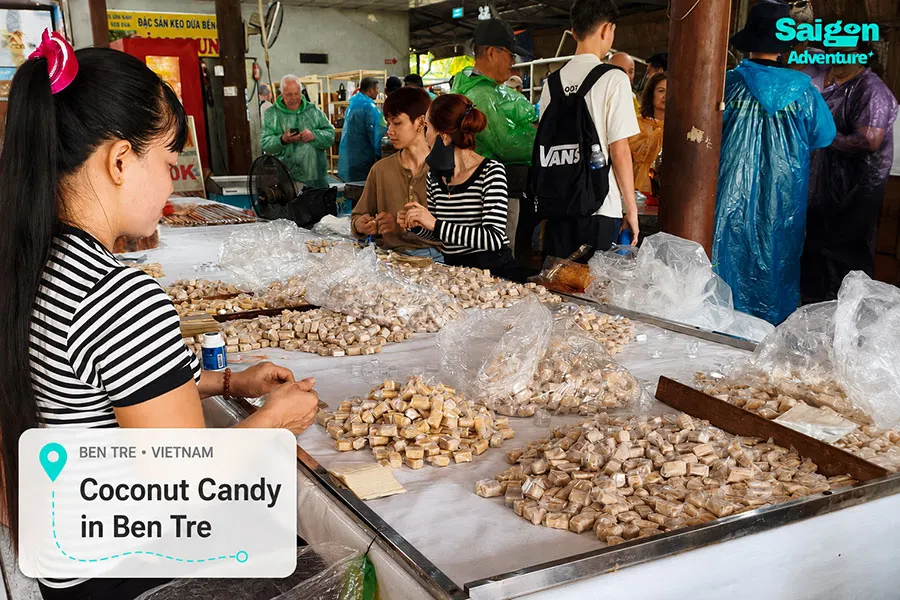
Before you see a Ben Tre coconut candy workshop, you usually smell it. Warm coconut thickens over the heat, toasted sugar lingers in the humid air, and a wide metal pan turns slowly from milky white to glossy gold.
Nearby, workers cut the soft candy into tidy rectangles and wrap each piece with astonishing speed. The finished sweet is small, but it tells a much larger story about the Mekong Delta: fertile gardens, family businesses, patient craftsmanship, and a community that has learned to find value in every part of the coconut tree.

Quick Answer: What Is Ben Tre Coconut Candy?
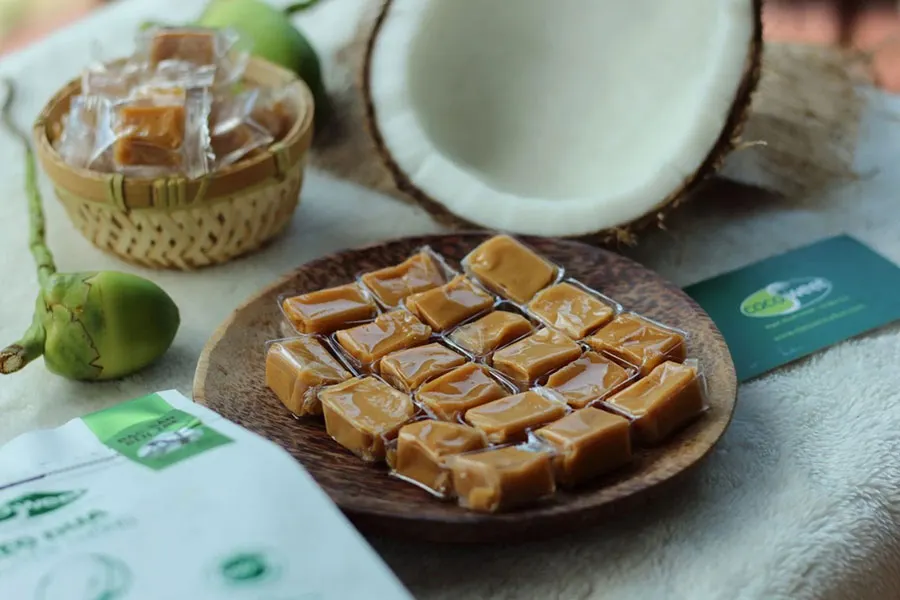
Coconut candy in Ben Tre, known locally as kẹo dừa, is a chewy Vietnamese sweet made from coconut milk or cream, sugar, and malt syrup. The mixture is slowly cooked, cooled, cut, and wrapped. More than a souvenir, it expresses Ben Tre’s coconut-growing culture and rural economy.
What Exactly Is Vietnamese Coconut Candy?
Ben Tre coconut candy is not a hard-boiled sweet or a bar filled with shredded coconut. Its texture sits between soft caramel and firm toffee, with a creamy finish and the fragrance of freshly pressed coconut milk.
The recipe is deliberately simple. Vietnam’s official tourism website describes the classic version as coconut milk and sugar; many makers add malt syrup for a smooth, elastic chew.
Taste it while a fresh batch is still warm, when it is softer and more aromatic than the packaged version.
Why Ben Tre Became Famous for Coconut Candy
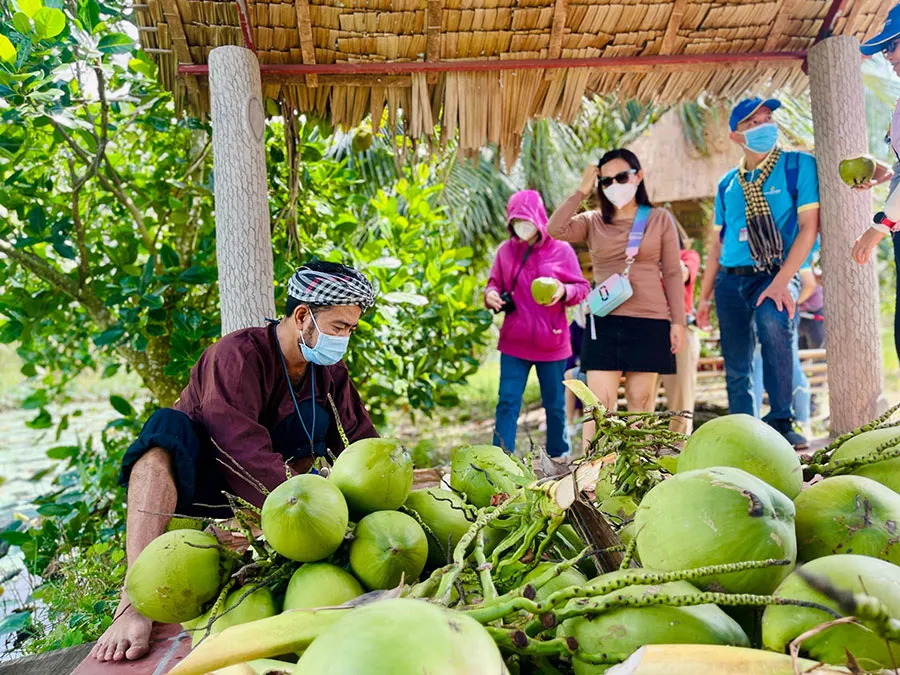
Ben Tre is known as Vietnam’s coconut land. Beyond the main roads, palms rise above gardens, lean over canals, and surround homes where the fruit is opened, dried, pressed, or transformed.
For local families, coconut is a practical resource. Its flesh, water, oil, fiber, and shell can become food, household products, fuel, or handicrafts.
Candy grew naturally from this resourceful way of life. It lasted longer, travelled farther, and carried more value than raw coconut alone.
The craft became associated with Mo Cay before spreading across Ben Tre. Over time, kẹo dừa became an edible symbol of the region.
This comparison of My Tho and Ben Tre helps travelers choose the Delta experience that suits them.
How Coconut Candy in Ben Tre Is Made
Modern workshops may mechanize pressing or stirring, but the essential process still depends on simple ingredients and careful judgment.
1. Choosing Mature Coconuts
Makers select mature coconuts with thick, high-fat flesh. Young drinking coconuts lack the concentrated richness needed for candy.
Poorly stored coconut leaves a stale aftertaste that sugar cannot hide.
2. Grating and Pressing the Coconut Flesh
The white flesh is cleaned, finely grated, and pressed to extract the opaque milk and cream that form the candy’s base.
Visitors may watch the liquid run from a simple press into a bowl—one of the freshest aromas in the workshop.

3. Adding Sugar and Malt Syrup
The coconut milk is combined with sugar and malt syrup, traditionally made from germinated rice. Malt helps create the cohesive, pleasantly chewy texture.
Proportions belong to each maker’s recipe and may change with the coconut’s richness.
4. Cooking the Candy Slowly
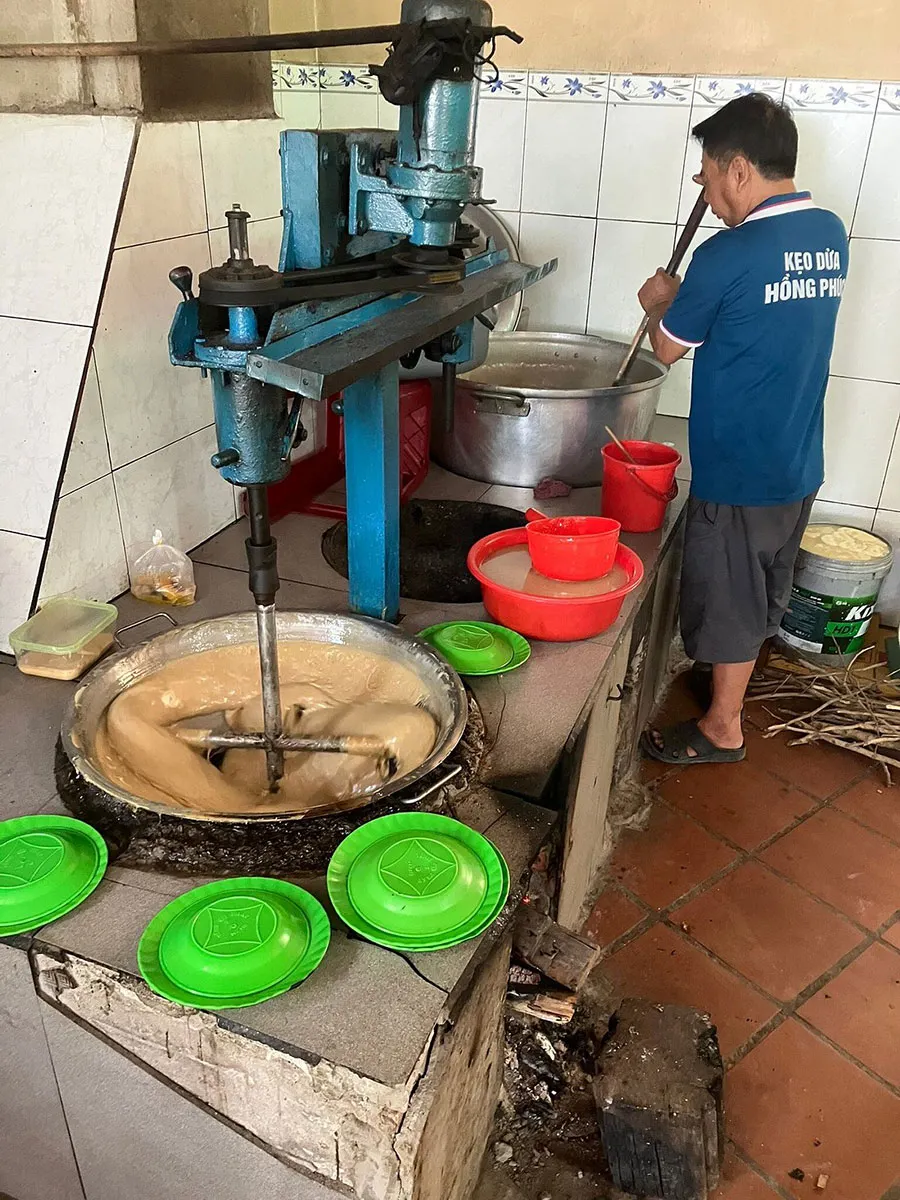
During sên kẹo, the mixture is heated and stirred continuously. Water evaporates as the pale liquid becomes a heavy, glossy mass.
A skilled maker reads how it folds and resists the paddle. Too little cooking creates sticky candy; too much makes it hard or bitter.
5. Cooling, Cutting, and Wrapping
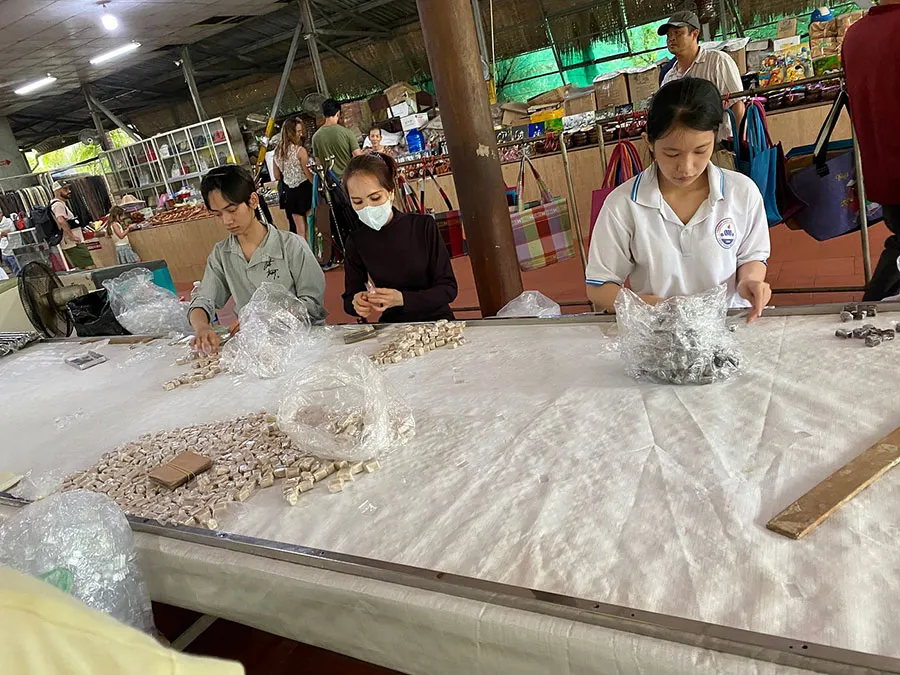
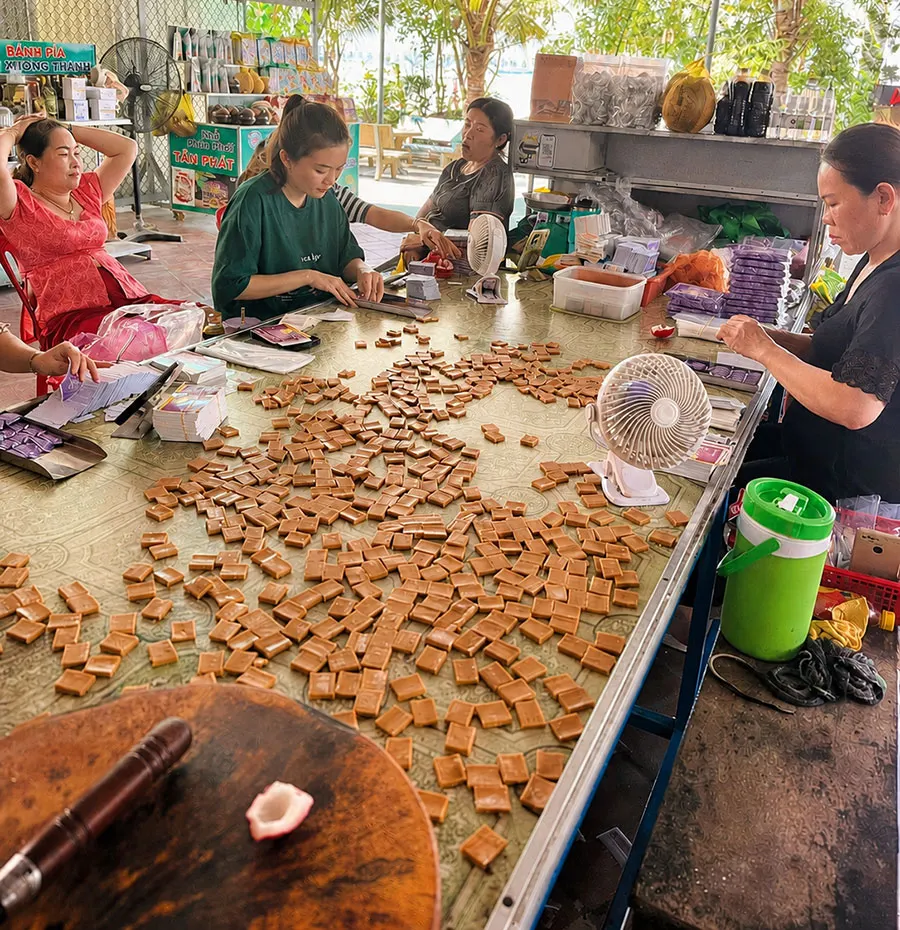
The warm mixture is spread across a table. While still flexible, it is divided into long strips and cut into small rectangles.
Some candy has an edible inner layer followed by paper. Packaging varies, so ask before eating any transparent wrapper.
Inside a Ben Tre Coconut Candy Workshop
The best workshops feel like working kitchens. Shells crack in one corner, steam rises from a pan, and experienced hands wrap candy without appearing to look down.
A warm sample is the highlight: softer, more fragrant, and richer than anything waiting in a souvenir box.
Pause near the cutting table and the craft becomes easier to appreciate. The workers must move while the candy is still pliable, creating uniform pieces before the cooling slab becomes too firm to shape cleanly.
Some stops show only cutting and wrapping. Ask before booking if you want to see an active cooking batch.
Most visits are brief, so use the time to ask what was made that day and which flavor the workers prefer. Always request permission before taking close-up photographs of staff.
Clean surfaces, clear ingredients, proper food handling, and sealed packages matter more than a polished showroom. Visitors should never feel pressured to buy.
Why Ben Tre Coconut Candy Still Matters
It Supports a Wider Chain of Local Livelihoods
Every package connects growers, collectors, drivers, candy makers, wrappers, retailers, and local guides.
Processing near the farms keeps more value in the community and lets small producers compete through flavor, texture, and reputation.
It Keeps Practical Knowledge Alive
Machines reduce physical labor, but aroma, humidity, resistance, and timing still require human judgment.
Thoughtful visits help keep that knowledge commercially relevant—a stronger form of preservation than a staged performance alone.
It Represents Ben Tre’s Remarkable Coconut Economy
In 2024, Vietnam’s Ministry of Industry and Trade reported more than 200 coconut-derived products in Ben Tre, from food and oil to fiber and activated carbon.
Coconut candy shows how one familiar crop can support agriculture, manufacturing, tourism, and cultural identity.
Which Coconut Candy Flavors Should You Try?
Begin with original coconut. It should be fragrant and creamy, with balanced sweetness and no stale-oil aftertaste.
Peanut adds crunch, pandan brings an herbal aroma, and durian is boldly distinctive. Coffee and cacao offer more modern variations.
Try a piece with unsweetened hot tea if it is offered. The slight bitterness refreshes the palate and makes the coconut aroma easier to notice between flavors.
Local tip: choose a small mixed pack first. The candy is rich, and comparing flavors is part of the fun.
Practical Tips for Buying Coconut Candy in Ben Tre
- Check the manufacturer, ingredient list, production date, and expiry date.
- Choose sealed, undamaged packaging if the candy will travel in warm luggage.
- Ask about peanuts, sesame, dairy, or shared equipment if you have allergies.
- Do not assume every flavored variety is vegan or suitable for a specific diet.
- Store the candy in a cool, dry place according to the package instructions.
- Keep the original label and check your destination’s customs rules before flying internationally.
How to Add a Workshop Visit to Your Mekong Delta Trip
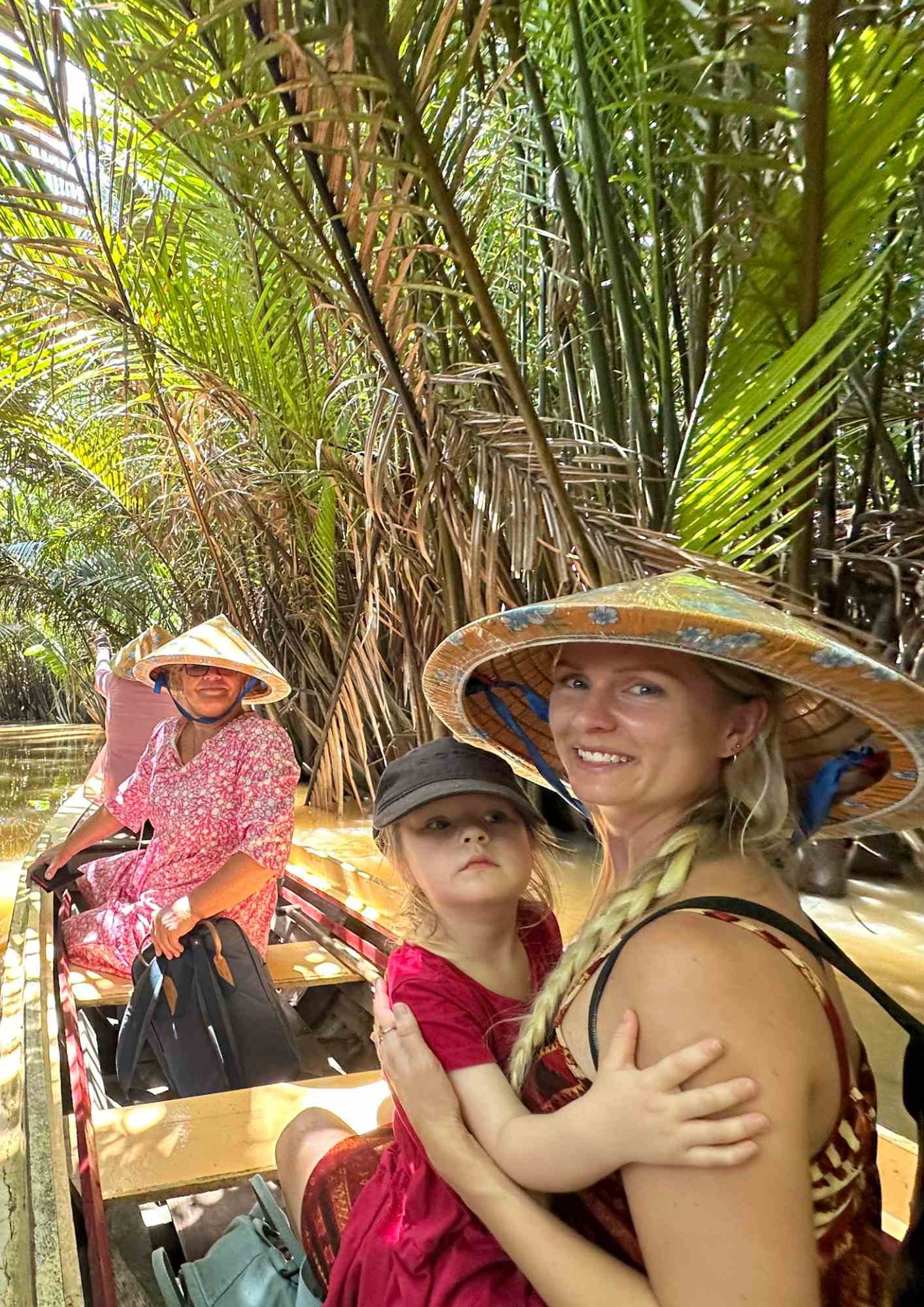
Combine the workshop with orchards, village lanes, river cruising, and a traditional sampan boat to see how the landscape and local economy connect.
Ask how long the stop lasts and whether production is active. A Mekong Delta tour by luxury speedboat also makes the river part of the journey.
Taste More Than a Souvenir
Watch Ben Tre coconut candy being made and each piece represents something larger: the palms outside, heat from the pan, experienced hands, and generations of ingenuity.
Explore Saigon Adventure’s Mekong Delta tours to meet the waterways, workshops, and communities behind the region’s flavors.
Frequently Asked Questions
What does Ben Tre coconut candy taste like?
It tastes creamy, fragrant, and gently caramelized, with a texture similar to soft toffee.
What are the main ingredients in Vietnamese coconut candy?
The traditional base is coconut milk or cream, sugar, and malt syrup. Flavored versions may contain nuts, fruit, coffee, or cacao.
Is the thin wrapper around coconut candy edible?
Some producers use an edible inner layer followed by a separate wrapper. Check the label or ask before eating it.
Can travelers visit a coconut candy workshop in Ben Tre?
Yes. Many Mekong Delta itineraries include one. Confirm beforehand if you specifically want to watch the cooking process.
Is coconut candy suitable for vegetarians or vegans?
The classic recipe is plant-based, but flavored products vary. Check the ingredients and ask about shared equipment if necessary.
Can international travelers take coconut candy home?
Usually, but food-import rules differ by country. Keep it sealed and labeled, then check your destination’s customs guidance.
Explore our best-selling tours
 Bestseller
Cu Chi Tunnels & Mekong Delta 1-Day Tour from Ho Chi Minh City
EXCURSION HIGHLIGHTS: AT CU CHI TUNNELS Watch Documentary Video (Only Showed In This Place) Experience The Thrill Of Crawling Into...
 Bestseller
Mekong Delta Tour
The Mekong Delta is celebrated as one of the world's most vital biological wonders and a premier cultural destination in...
 Bestseller
A Less-Touristy Mekong Delta Day Trip to Ben Tre
Delta Tour 1 Day from Ho Chi Minh City, exploring the peaceful waterways and coconut villages of Ben Tre. This...
 Bestseller
Mekong Delta Tour by Luxury Speed Boat
OVERVIEW Hotel pickup: From 8:00 AM in District 1 Tour duration: Approximately 8 hours Group size: Maximum 12 guests Price:...
 Bestseller
Mekong Delta 2 Days Tour – Floating Market Group Tour
Cai Rang floating market – one of the largest floating market in the Mekong Delta is a rare sight in...
 Bestseller
Mekong Delta One Day Group Tour
ABOUT THIS MEKONG DELTA TOUR Departure: 8:00 AM Drop off time: 5:30 PM to 6:30 PM Small group travel experience...
 Bestseller
12-Hour Cai Rang Floating Market & My Tho Tour From Saigon
ABOUT THIS TOUR Discover the Cai Rang floating market, a colorful, buzzing market with hundreds of boat vendors selling fruits,...
 Bestseller
3-Day Mekong Delta Floating Market Tour with Flexible Exit
Tourists often choose to explore and experience this unique floating market by boat when participating in tours exploring the Mekong...
 Bestseller
Can Tho: Floating Market & Garden Life in the Delta
FLOARING MARKET TOUR Note: This tour pick up and drop off in Can Tho only The Ultimate Can Tho Floating...

Private Car Rental Services
Why you should choose car rental with Saigon Adventure ? We understand that make plan your trip, you wish your...

2 DAYS MEKONG DELTA FLOATING MARKET – CAN THO – RACH GIA
Join Saigon Adventure for our exclusive 2-Day tour, highly recommended among the best Mekong Delta tours for travelers who want...

2 Days Mekong Delta Homestay
Looking for an authentic Mekong Delta Homestay experience? Keep your travel plan flexible - book your spot now and pay...