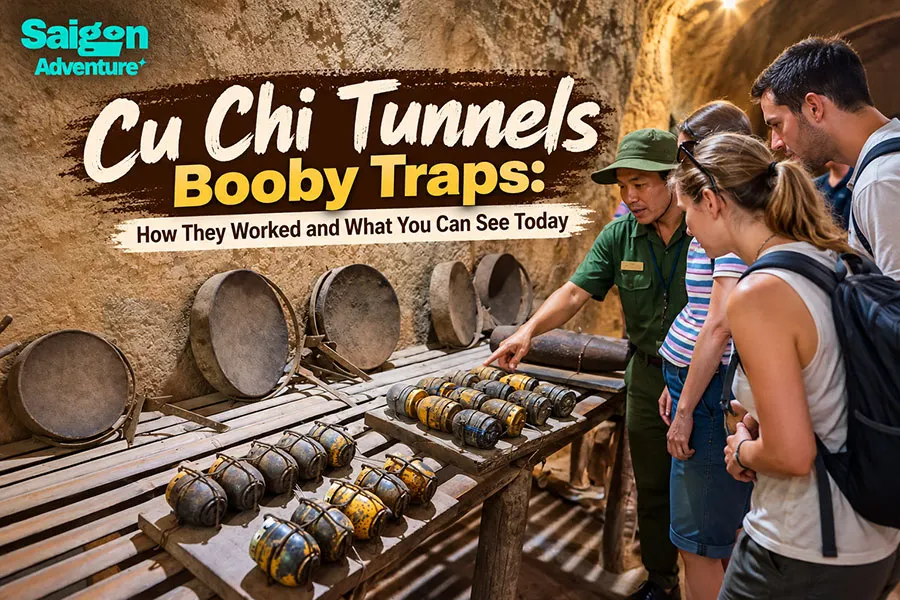
At the Cu Chi Tunnels, you see reconstructed booby traps shown by a guide along the walking trail. They are display models, not live traps. Visitors usually see a few types, including a door trap, a see-saw trap and a swinging trap set in a pit.
This guide explains what the Cu Chi Tunnels booby traps were for, which types you can see today and how to visit the displays safely. It describes the traps at the level of a museum placard. It does not explain how to build one. For the full tour flow, see our guide to what to expect on a Cu Chi Tunnels tour.
Tourists learning about Cu Chi Tunnels trap system during guided tour.
What Were the Cu Chi Tunnels Booby Traps?
The traps were hidden defenses placed in the Cu Chi area during the war. They were triggered by a step, a fall or a tripwire. Guides explain that many were meant to injure and slow a person, not always to kill. They worked alongside camouflage and hidden entrances, as part of a wider system of defense.
Why Traps Were Part of the Tunnel Defense
The tunnels were hard to find by design. Entrances were small and covered with leaves and soil. Air shafts and kitchen smoke were also disguised. Traps added another layer, because a searching patrol had to move slowly and carefully.
Guides usually present traps as a tool of a poorly equipped force facing heavy firepower. That is the Vietnamese view of the war, and it shapes the story you hear on site. If you want the background, read how the tunnels were built in our guide on how the Cu Chi Tunnels were constructed. For the hidden doors themselves, see our article on the secret entrances of the Cu Chi Tunnels.
What Were the Traps Made From?
Several visitor accounts say wartime spikes were made from bamboo and from scrap metal taken from shells. The displays you see today often use metal spikes. Ask your guide what each model is made of, since materials on display can differ from the originals.
Types of Cu Chi Booby Traps You Can See Today
Names on signs and in guides vary a little between sites and translators. The table lists types visitors commonly report.
| Trap | How guides describe it | What you see today |
|---|---|---|
| Door trap | A spiked wooden section hung above a doorway, released by a tripwire | A reconstructed frame near a doorway |
| See-saw trap | A tilting platform over a pit | A model with the pit open for viewing |
| Swinging-up trap | A hidden mechanism set in a pit | A reconstructed pit shown by a guide |
| Fish trap | A pit trap named for its shape | A reconstructed pit shown by a guide |
Visitors also mention a folding chair trap, a window trap and a rolling trap. Not every type appears at every stop, and the selection can change, so check on the day.
Local guide demonstrating wartime equipment at the Cu Chi Tunnels.
What the Traps Look Like on Your Visit
Reconstructions, Not Live Traps
The displays are demonstrations. A guide points out the trap, explains the idea and sometimes shows how it is set off on a model. You stand behind a rail or a marked line while the guide talks.
Demonstration Entrances Are Not the Original Tunnels
Visitors also see a small hidden hatch, where a guide steps in and disappears. These entrances are for show, and one traveler reports they do not lead into the real tunnels. The secret entrances article above explains the difference.
Secret entrance of the Cu Chi Tunnels concealed with leaves, soil and natural forest camouflage.
Ben Dinh or Ben Duoc for the Traps?
Both sites have trap exhibits, according to one detailed visitor review. Areas open to tourists are reinforced at both, and some entrances were widened. Ben Duoc is farther out and less crowded. If you are choosing between them, read our Ben Dinh vs Ben Duoc comparison.
What Else You See Near the Trap Displays
The traps are one stop on a looping walking trail. Visitors commonly report an orientation hut with a map and a cross-section model of the tunnel system. Some groups also watch a short documentary before the walk begins.
Along the trail you may see displays of deactivated American shells and bombs, a wartime tank and a recreated tunnel kitchen. Seen together, they show how the tunnel network combined hiding places, daily life and defense. The tour guide linked in the introduction walks through that order of stops.
How Much Time the Trap Stop Takes
The trap stop is short. A guide usually spends a few minutes on each display, so it fits easily into a half-day visit. In our view, the traps are worth the most when the guide connects them to the rest of the defense, not when they are viewed as a single curiosity.
Best Time to See the Displays
Go in the morning if you can. The trail is outdoors, and the heat builds by midday. Smaller groups also make it easier to hear the guide and see the displays up close.
Safety and Etiquette at the Trap Displays
Treat each display as a real wartime object. These steps help you stay safe and respectful:
- Stay on the marked path and behind rails.
- Do not touch, step on or try to trigger a model.
- Keep children close, since pits and spikes sit near the trail.
- Wear closed shoes. Surfaces can be uneven and damp.
- Ask before you take close-up photos of the guide’s demonstration.
Local tip: Some travelers find the cheerful demonstration style odd given the subject. Remember that the injuries these traps caused were real, and a quiet tone suits the place.
Travelers learning about wartime life inside the Cu Chi Tunnels during a guided tour.
Are the Trap Displays Worth Your Time?
Yes for most visitors, because they explain how a low-technology force protected the tunnels. They suit history readers, teenagers and adults who want context for the crawl. They are less suited to very young children or anyone who finds weapon displays upsetting.
You can skip the close viewing and still enjoy the visit. Stand back at the rail, listen to the guide and move on. The site has plenty of other stops, including the hidden entrances, the kitchen area and the walking trail through the forest. This is a personal view, not a site rule, so follow your own comfort level.
Questions to Ask Your Guide
A guide adds context that signs do not. Good questions include:
- Is this a replica or an original, and what is it made of?
- How were traps placed, and how did local people avoid their own traps?
- What other defenses worked with the traps?
- Which parts of this display have been changed for visitors?
Our Cu Chi history guide is a useful read before you go, so the answers make more sense.
Frequently Asked Questions
Are the Cu Chi booby traps real?
No, the traps on display are reconstructions. They show the design of the wartime originals but are set up for visitors, with guides supervising.
Can you touch the booby traps at Cu Chi?
No. Stay behind the rails and follow your guide’s instructions. The models have sharp parts, and touching them is unsafe.
Do you see booby traps inside the tunnels?
The displays sit along the walking trail, not inside the crawl sections. Check with your guide if you plan to crawl, since layouts differ by site.
Are the traps suitable for children?
Younger children can see them, but pits and spikes need close supervision. The wartime subject may also be heavy for some children, so prepare them first.
Do both Ben Dinh and Ben Duoc have booby traps?
Yes, according to visitor reports. Exact displays differ, so ask your guide what is on the route that day.
What were Cu Chi traps made from?
Accounts mention bamboo and scrap metal from shells. Today’s displays often use metal spikes, so models may not match the originals.
Visit the Traps With a Guide
A good guide makes the displays much easier to understand. If you want a Cu Chi trip with clear explanations and hotel pickup, browse our Cu Chi Tunnels tours and tell us your group size and preferred site.