The Cu Chi Tunnels are often described as an underground maze, but that simple phrase does not fully explain their remarkable design. Beneath the rural landscape northwest of Ho Chi Minh City, local forces created a connected system of passages, shelters, kitchens, meeting rooms, storage areas and defensive positions. Much of the work was completed by hand, using basic tools and knowledge of the local terrain.
Understanding how the Cu Chi Tunnels were built makes a visit far more meaningful. The narrow entrances and dark passages were only part of a carefully organized underground environment designed around concealment, survival and movement.

When did construction of the Cu Chi Tunnels begin?
The earliest tunnels in the Cu Chi area are generally associated with the resistance against French colonial forces in the late 1940s. At first, they were relatively simple structures used to hide people, store documents and protect supplies. Individual villages often maintained their own sections rather than forming one continuous network.
During the Vietnam War, the system was enlarged and adapted. Tunnels connected defensive positions, command areas and settlements across a wider landscape. They allowed people to move while reducing their exposure above ground, particularly in areas affected by military operations.
Today, travelers can learn how these individual features worked together on a Cu Chi Tunnels tour by car from Ho Chi Minh City. Exploring with a local guide helps connect the small details visible at the site with the much larger story below the ground.
Why was the soil at Cu Chi suitable for tunneling?
The physical landscape played an important role in the construction of the Cu Chi Tunnels. The area contains firm lateritic soil with clay-like qualities. During excavation, this earth could be cut with hand tools. Once exposed to air and dry conditions, it became harder and more stable.
Drainage was another important consideration. Builders had to understand how water moved through the landscape during the rainy season. A poorly positioned tunnel could flood, become muddy or collapse. Entrances, connecting corridors and lower sections therefore had to be planned around the natural behavior of the soil.
The surrounding vegetation also supported concealment. Forest, plantations and rural terrain made it possible to disguise entrances and ventilation openings among roots, leaves and uneven ground. The landscape above and the construction below worked as one defensive environment.
How were the Cu Chi Tunnels dug by hand?
Most tunnel construction relied on simple tools such as hoes, shovels, picks and baskets. Workers loosened the compact earth, collected it and moved it away from the excavation area. Because entrances and corridors were narrow, the process was slow and physically demanding.
Removing the excavated soil without revealing the tunnel was a serious challenge. A large, fresh pile of earth would expose the location immediately. Soil therefore had to be dispersed discreetly. It could be spread over cultivated ground, used around defensive positions or carried to places where its color and texture would not attract attention.
The compact dimensions also had a purpose. Smaller tunnels required less soil to be removed and were harder for larger enemy soldiers to enter. Narrow bends limited visibility, slowed movement and made it difficult for an unfamiliar visitor to understand the layout.
The three-level structure beneath the ground
Descriptions of the Cu Chi Tunnels commonly refer to a system built across three levels. The exact depth and arrangement varied by location, but the layered design provided different degrees of protection and supported different activities.
- Upper level: The first level was closest to the surface and allowed relatively quick movement and access. It could connect entrances, observation areas and defensive positions, but it was also the most exposed to bombardment and surface activity.
- Middle level: Deeper passages offered greater protection and could connect living spaces, storage rooms, meeting areas and other facilities. These sections helped people remain below ground during dangerous periods.
- Lower level: The deepest routes provided additional shelter and possible escape paths. They were more difficult to construct and faced greater challenges involving air, water and emergency access.
Visitors should remember that the preserved experience available today represents only selected parts of a much larger system. Some visitor passages have been stabilized or adapted for safety and accessibility. They still communicate the confined nature of the tunnels, but they do not reproduce every condition experienced during wartime.
Secret entrances and concealed trapdoors
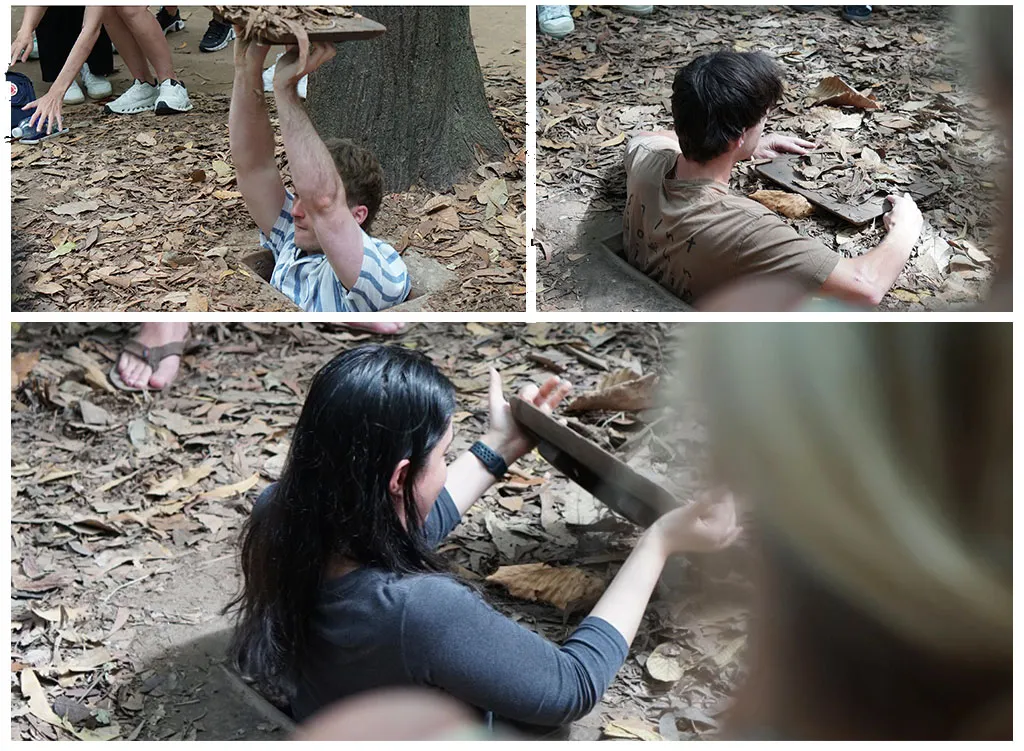
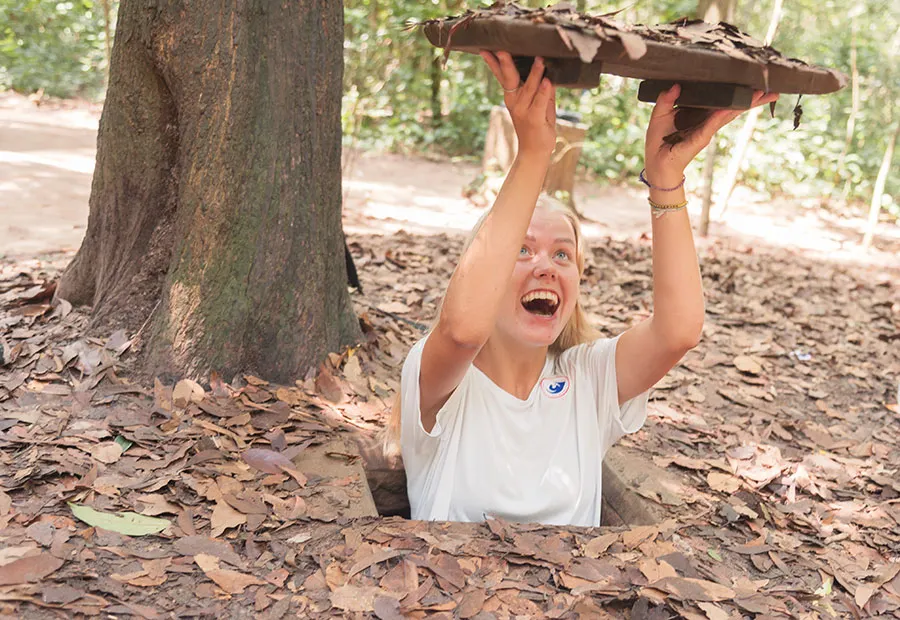
One of the most recognizable features at Cu Chi is the small rectangular trapdoor hidden beneath leaves. These entrances demonstrate how carefully the underground system was integrated into its surroundings.
The opening had to be large enough for a person familiar with it to enter quickly, yet small enough to remain difficult to notice. A fitted cover could be coated with local soil and natural material so that it blended into the forest floor. Once leaves were scattered over it, the entrance could almost disappear.
Concealment depended on discipline as much as construction. Repeated footprints, disturbed vegetation, displaced soil or careless smoke could reveal an otherwise well-designed entrance. The tunnel system worked because the people using it understood how to protect the landscape above it.
How did ventilation work inside the Cu Chi Tunnels?
Airflow was essential. Without ventilation, underground rooms and long passages would quickly become dangerously hot and difficult to breathe in. Builders created narrow air shafts connecting the tunnels with the surface. The challenge was allowing air to enter without revealing what lay below.
Ventilation openings could be concealed in termite-mound-like structures, vegetation or other natural-looking features. Their small size made them less noticeable, while their placement supported airflow through occupied sections.
On a guided visit, seemingly ordinary mounds or holes become important evidence of the network’s engineering. A knowledgeable explanation helps visitors recognize that survival depended not only on digging passages but also on solving the everyday problems created by living below ground.
Underground kitchens and the Hoang Cam stove
Cooking presented one of the greatest risks inside the tunnels. A normal fire produced smoke that could rise visibly above the ground and reveal the location of an underground kitchen.
The Hoang Cam stove addressed this problem through a system of chambers and smoke channels. Instead of allowing smoke to escape directly above the fire, the design guided it through underground flues. By the time it reached several small outlets farther away, it had cooled and dispersed. The resulting smoke was less concentrated and more difficult to detect.
Cooking schedules also mattered. Food was often prepared at times when mist or low light could make smoke less visible. This combination of design and routine reduced risk.
Meeting rooms, medical areas and storage spaces
The Cu Chi underground network included spaces serving different purposes. Larger chambers could be used for meetings or planning. Other areas stored food, medicine, documents or equipment. Medical spaces provided basic treatment for injuries and illness.
These rooms were not comfortable in the conventional sense. Space was limited, lighting was poor and conditions could be hot and humid. Even so, separating activities into designated areas made the network more functional. It allowed communication, organization and essential care to continue when surface movement was dangerous.
For more insight into the human experience, read Daily Life Inside the Cu Chi Tunnels. It explains how people managed basic needs while living and working beneath the forest floor.
Defensive features and emergency escape routes
The structure of the tunnels was designed to slow and confuse anyone unfamiliar with the system. Tight corners interrupted sight lines. Narrow sections restricted movement, while trapdoors could isolate one part of the network from another. Some areas were associated with defensive traps and protected fighting positions above ground.
Escape planning was equally important. A tunnel without an alternative exit could become a trap for its occupants. Secondary routes allowed movement away from danger when one section was compromised. Some accounts describe exits connected with waterways or distant areas, demonstrating how closely the underground passages were linked to the surrounding landscape.
Can visitors enter the original Cu Chi Tunnels today?
Visitors can enter designated tunnel sections at the Cu Chi sites, but the experience is controlled for safety. Some passages used for tourism have been reinforced, maintained or widened. Even with these adaptations, they remain low, narrow and dark enough to give travelers a strong sense of the physical environment.
Entering a tunnel is optional. Travelers who experience claustrophobia, limited mobility, knee or back problems, breathing difficulties or anxiety in confined spaces can remain above ground. Many important features—including entrances, bunkers, ventilation displays, traps and reconstructed facilities—can be understood without crawling through a passage.
If you decide to enter, listen to the guide and leave at the nearest exit if you feel uncomfortable. For more detail, see What Is It Like to Crawl Through the Cu Chi Tunnels?.
Why seeing the tunnels with a guide makes a difference
Many of the most ingenious features at Cu Chi are deliberately difficult to notice. Without context, a visitor may see only a small hole, a mound of earth or a dark room. A local guide can explain how these separate details formed a working system and distinguish preserved elements from reconstructed displays.
A typical tour from Ho Chi Minh City combines transportation, an introduction to the site’s history, guided exploration and time to view the underground features. Travelers can choose whether to enter the tunnels and can ask questions about the construction, daily life and modern preservation of the site.

Frequently asked questions
How long did it take to build the Cu Chi Tunnels?
The network was not completed in a single construction period. Early sections developed from the late 1940s, while the system was expanded and adapted over subsequent years as local needs and wartime conditions changed.
How deep were the Cu Chi Tunnels?
Depth varied across the network. The commonly described three-level system included shallow access passages and deeper protective sections. Local soil, water and the purpose of each section affected its depth.
Were the tunnels built entirely by hand?
Much of the excavation was performed manually using simple digging tools and baskets. Builders also had to remove and disperse the excavated earth without exposing the tunnel locations.
How did people breathe underground?
Small ventilation shafts brought air from the surface. Their openings were carefully concealed in natural-looking features such as vegetation or termite-mound-like structures.
Did people cook inside the tunnels?
Yes. Underground kitchens used smoke-dispersal techniques associated with the Hoang Cam stove. Channels cooled and divided the smoke before it reached concealed outlets at the surface.
Do visitors have to crawl through a tunnel?
No. Tunnel entry is optional. Visitors can stay above ground and still see many historical displays, reconstructed facilities and concealed features.
Explore the Cu Chi Tunnels from Ho Chi Minh City
The Cu Chi Tunnels reveal far more than an ability to dig underground. Their layered passages, concealed entrances, ventilation shafts, smoke-control system and emergency routes demonstrate how local knowledge was applied to an extreme environment.
Seeing these details in person makes their scale and purpose easier to understand. If you would like to explore the site with transportation and an English-speaking local guide, consider Saigon Adventure’s Cu Chi Tunnels tour by car from Ho Chi Minh City. Morning and afternoon options make it easier to include this historic destination in your Ho Chi Minh City itinerary.