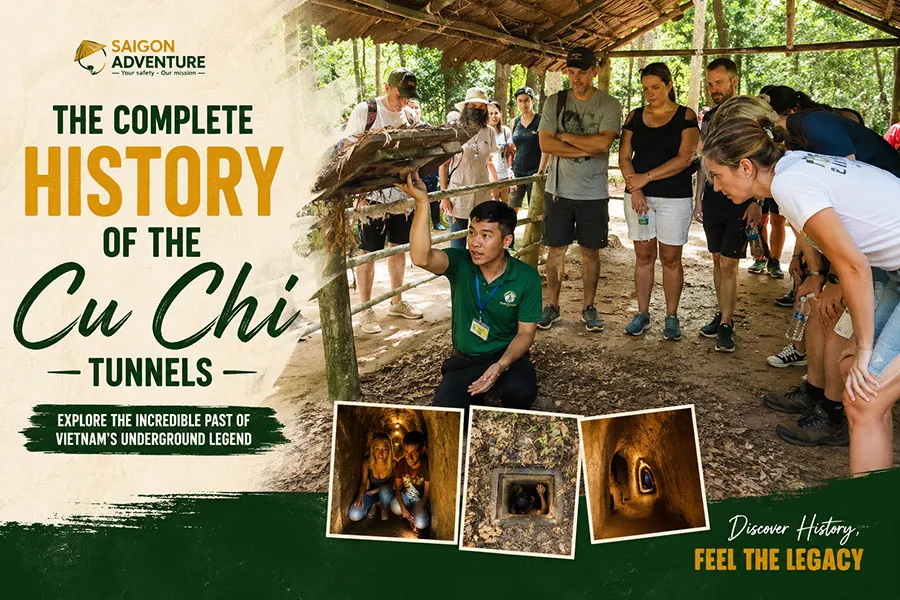
Standing in the quiet countryside northwest of Ho Chi Minh City, it is hard to imagine that an entire underground world exists just below the surface. Birds sing from the trees, farmers work nearby, and travelers walk along shaded paths. Yet beneath this peaceful landscape lies one of the most remarkable military engineering achievements in modern history—the Cu Chi Tunnels.
For many visitors, exploring the tunnels is one of the highlights of a trip to Vietnam. Crawling through narrow passages, seeing hidden entrances, and learning about life underground offers a perspective that no history book can fully capture. But the story of the Cu Chi Tunnels is far more than a tale of war. It is a story of ordinary villagers, remarkable ingenuity, and an unbreakable determination to survive against overwhelming odds.
Understanding the complete history of the Cu Chi Tunnels transforms a simple visit into a meaningful journey through Vietnam’s past. From their humble beginnings during the struggle against French colonial rule to their role in the Vietnam War and their preservation as one of the country’s most visited historical landmarks, the tunnels continue to tell a powerful story that resonates with travelers from around the world.
If you’re planning a Cu Chi Tunnels Tour, learning the history before your visit will help you appreciate every part of this extraordinary underground network.

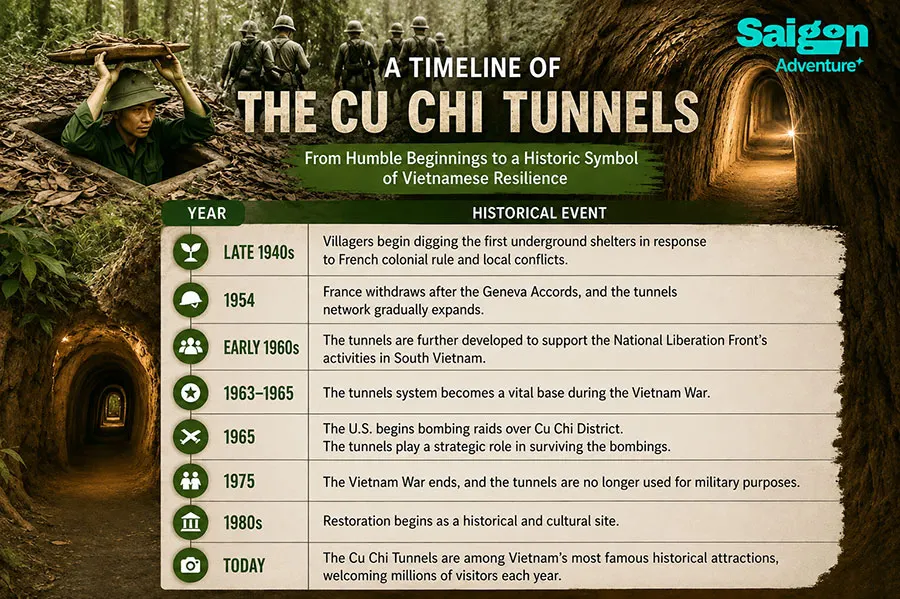
A Timeline of the Cu Chi Tunnels
Before exploring the details, here’s a quick look at the major milestones in the tunnels’ history.
| Year | Historical Event |
|---|---|
| Late 1940s | Villagers begin digging the first underground shelters during the First Indochina War. |
| 1954 | France withdraws after the Geneva Accords, and the tunnel network gradually expands. |
| Early 1960s | Construction accelerates as political tensions increase in South Vietnam. |
| 1965–1968 | The tunnel system becomes a major underground base during the Vietnam War. |
| 1968 | The tunnels play a strategic role during the Tet Offensive. |
| 1975 | The Vietnam War ends, and the tunnels are no longer used for military purposes. |
| 1980s | Selected sections are preserved and opened to visitors. |
| Today | The Cu Chi Tunnels are among Vietnam’s most famous historical attractions, welcoming millions of visitors each year. |
The Birth of the Cu Chi Tunnels
More Than a Wartime Creation
One of the biggest misconceptions about the Cu Chi Tunnels is that they were built entirely during the Vietnam War. In reality, their history began decades earlier.
In the late 1940s, during the First Indochina War, local villagers in Cu Chi started digging small underground shelters to protect themselves from military operations. These early tunnels were simple and practical, serving as hiding places where resistance fighters could avoid detection, store food, and hold secret meetings.
At first, each village built its own isolated tunnel system. Over time, these small shelters gradually connected, forming a growing underground network that stretched across the countryside.
What began as a survival strategy would eventually evolve into one of the most sophisticated tunnel systems ever constructed by hand.

Why Cu Chi Was the Perfect Location
Geography Shaped History
Not every region of Vietnam could support an underground network of this scale. Cu Chi offered several natural advantages that made tunnel construction possible.
Hard Laterite Clay
The soil in Cu Chi contains a high concentration of laterite clay, which becomes remarkably strong once exposed to air.
Unlike loose sand, the hardened clay allowed tunnels to remain stable without requiring extensive wooden supports. This natural strength made it possible to build long underground passages that could withstand both time and pressure.
Even today, many original sections remain structurally intact decades after they were first excavated.
Dense Forest and Natural Camouflage
Before urban development transformed the region, Cu Chi was covered by thick forests, bamboo groves, and rubber plantations.
The dense vegetation concealed tunnel entrances and ventilation holes, making aerial observation extremely difficult. Small openings could disappear beneath fallen leaves or blend seamlessly into the surrounding landscape.
For anyone unfamiliar with the area, finding an entrance was almost impossible.

A Strategic Position Near Saigon
Located approximately 70 kilometers northwest of present-day Ho Chi Minh City, Cu Chi occupied an important strategic position between rural communities and the capital.
Its location enabled people to move supplies, exchange information, and travel discreetly while remaining close to key transportation routes. This geographic advantage later contributed to the tunnels’ growing importance during the Vietnam War.
Expanding Into an Underground City
From Individual Shelters to a Vast Network
Following the Geneva Accords in 1954, Vietnam entered a new and increasingly complex political period. As tensions escalated, local communities expanded the existing tunnel system far beyond its original purpose.
Instead of isolated hiding places, engineers and villagers created interconnected passageways linking entire villages together.
Construction became a continuous process. Whenever new sections were completed, additional branches extended even farther, eventually forming a vast underground network believed to exceed 250 kilometers (155 miles) in total length.
This remarkable achievement was accomplished without modern machinery.
Built by Hand With Extraordinary Determination
Perhaps the most astonishing aspect of the Cu Chi Tunnels is how they were constructed.
There were no excavators, bulldozers, or heavy equipment.
Everything was dug by hand using simple tools such as:
- Short-handled hoes
- Small shovels
- Bamboo baskets
- Metal containers
- Handmade digging tools
Excavated soil could not simply be piled nearby, as this would immediately reveal the tunnels’ location.
Instead, workers carried the soil away in small baskets, spreading it across rice fields, filling bomb craters, or quietly disposing of it in nearby rivers. Every detail required careful planning to avoid detection.
Most digging took place after sunset, often continuing through the night before workers returned to their farms at dawn.
The construction of the tunnels was not only physically exhausting but also incredibly dangerous, demanding patience, teamwork, and exceptional resilience.

Engineering That Was Decades Ahead of Its Time
An Underground World Designed for Survival
The Cu Chi Tunnels were far more than narrow passageways. They functioned as a carefully engineered underground city where people could live, work, communicate, and survive for extended periods.
Every section served a specific purpose.

Living Quarters
Small underground rooms provided places to rest during periods of conflict.
Although cramped by modern standards, these spaces offered protection from aerial attacks and military patrols above ground.
Entire families sometimes shared these compact shelters, adapting to life in darkness with remarkable resilience.

Command Centers
Underground meeting rooms allowed leaders to coordinate activities without exposing themselves to danger.
These chambers became vital communication hubs where important decisions could be made in relative safety.
Kitchens With Hidden Smoke Systems
One of the most ingenious engineering solutions was the underground kitchen.
Cooking smoke normally rises in a visible column, easily revealing a hidden location.
To solve this problem, specially designed ventilation channels dispersed smoke over long distances, releasing it gradually through multiple concealed openings disguised as termite mounds or natural vegetation.
By the time the smoke reached the surface, it had cooled and spread so thinly that it became extremely difficult to detect.

Underground Medical Stations
Despite limited equipment, medical treatment was carried out below ground.
Basic operations, emergency care, and recovery areas were established inside reinforced chambers.
For many people living within the tunnel system, these underground clinics became the only available source of medical assistance during periods of intense conflict.

Life Inside the Cu Chi Tunnels
A Community Beneath the Surface
Life inside the Cu Chi Tunnels was defined by constant adaptation. The underground passages were narrow, humid, and often uncomfortably hot. Sunlight rarely reached those who spent extended periods below ground, and fresh air depended on carefully concealed ventilation shafts.
Yet despite these harsh conditions, daily life continued.
People cooked meals, repaired clothing, studied, shared news, cared for children, and supported one another in spaces that were often no larger than a small bedroom. Resourcefulness became a way of life, and every square meter of the tunnel system was designed to serve a purpose.
For today’s visitors, walking through the preserved sections offers only a glimpse of what that experience was like. Many of the passages have been widened to accommodate international tourists, but even so, most travelers quickly discover how physically demanding the underground environment remains. Crawling through the tunnels for just a few minutes is enough to appreciate the endurance required of those who once called this hidden world home.
The Role of the Cu Chi Tunnels During the Vietnam War
An Underground Network That Changed Military Strategy
By the mid-1960s, the Cu Chi Tunnels had grown into far more than a collection of hidden shelters. They had become a sophisticated underground network that connected villages, supply routes, command centers, medical stations, and defensive positions. This extensive system allowed people to move across the region while remaining hidden from aerial surveillance and ground patrols.
Instead of relying on roads or open trails, movement often took place beneath the surface. Supplies, messages, food, and medical equipment could be transported through the tunnels, reducing the risks associated with traveling above ground. The network also allowed people to emerge unexpectedly at different locations before disappearing underground again.
Although the tunnels played an important military role, they also served as a place where local communities sought protection during periods of heavy fighting. Their history is therefore not only one of strategy, but also of survival and resilience.
The Tet Offensive and the Cu Chi Tunnels
A Defining Moment in History
One of the most significant chapters in the history of the Cu Chi Tunnels was the Tet Offensive in 1968.
During this large-scale military campaign, the tunnel network functioned as an important logistical base. Underground passages allowed personnel, supplies, and communications to move with greater secrecy before operations took place.
Today, historians continue to study the Tet Offensive as a turning point in the Vietnam War. While the conflict itself remains a complex historical subject with many perspectives, there is broad agreement that the Cu Chi Tunnels demonstrated how extensive underground infrastructure could influence military operations despite overwhelming technological challenges.
For visitors today, understanding this historical context adds depth to every section of tunnel they explore.
Remarkable Engineering Features
A Three-Level Underground System
One reason the Cu Chi Tunnels survived for so many years was their intelligent design.
Rather than existing on a single level, many sections were constructed across multiple depths.
First Level
Located approximately 3 to 4 meters below ground, this level connected nearby areas and allowed relatively quick movement.
Second Level
Around 6 meters underground, this level provided greater protection during periods of bombardment.
Third Level
Some sections reached depths of 8 to 10 meters, offering additional security and emergency escape options if upper passages became unusable.
This layered structure meant that even if one section was damaged, alternative routes often remained accessible.
Hidden Entrances
Perhaps the most famous feature of the Cu Chi Tunnels is their remarkably small entrances.
Many original openings measured less than 40 centimeters across and were carefully concealed beneath removable wooden covers covered with soil, leaves, and vegetation.
To an untrained eye, these entrances blended perfectly into the forest floor.
Even today, many visitors are surprised when guides reveal entrances they had unknowingly walked past.
Ventilation Without Detection
Fresh air was essential for anyone living underground.
Hundreds of ventilation shafts were built throughout the tunnel network, but they were carefully disguised as termite mounds, tree roots, or natural landscape features.
This clever design allowed air to circulate while minimizing the chances of being discovered.
Everyday Life Below Ground
More Than Survival
Life inside the tunnels involved much more than simply hiding.
People created routines that helped maintain a sense of normality despite difficult conditions.
Daily activities included:
- Preparing simple meals
- Repairing clothing and equipment
- Collecting water
- Caring for children
- Holding meetings
- Studying and teaching
- Providing medical treatment
Although space was extremely limited, the underground community demonstrated remarkable adaptability.
For modern travelers, this human aspect is often the most memorable part of visiting the Cu Chi Tunnels.
What People Ate
Food was simple, practical, and locally available.
Typical meals included:
- Cassava
- Sweet potatoes
- Rice when available
- Seasonal vegetables
- Peanuts
- Sesame salt
Cassava became closely associated with the Cu Chi Tunnels because it was nutritious, easy to grow, and capable of surviving challenging conditions.
Today, many guided tours offer visitors boiled cassava with sesame salt, allowing them to experience one of the foods historically connected with the site.
Fascinating Facts You May Not Know
10 Interesting Facts About the Cu Chi Tunnels
- The tunnel network is believed to have stretched more than 250 kilometers (155 miles).
- Nearly every section was dug by hand using basic tools.
- Some ventilation openings were disguised as termite mounds.
- Certain tunnel passages were intentionally built with sharp turns to reduce the effects of explosions and smoke.
- Underground kitchens were designed to disperse smoke over long distances before it reached the surface.
- Medical clinics, storage rooms, meeting areas, and living spaces existed within the network.
- Different tunnel sizes were designed for different purposes rather than following a single standard layout.
- Many sections visible today have been widened slightly to improve visitor safety.
- The tunnels are considered one of Vietnam’s most important historical attractions.
- Millions of domestic and international travelers visit the Cu Chi Tunnels every year.

Ben Dinh vs. Ben Duoc
Which Site Should You Visit?
Most travelers visit one of two preserved sections of the Cu Chi Tunnels.
Ben Dinh
Ben Dinh is the closest site to Ho Chi Minh City and the most popular option for half-day tours.
It features reconstructed tunnel sections that are slightly wider than the originals, making them more comfortable for first-time visitors while still providing an authentic experience.
This site is ideal for travelers with limited time.

Ben Duoc
Ben Duoc offers a quieter atmosphere and a stronger emphasis on historical preservation.
Visitors can explore larger memorial areas, enjoy fewer crowds, and gain a deeper understanding of the site’s historical significance.
Those interested in Vietnam’s history often appreciate the more reflective environment found here.
After exploring the tunnels, many travelers continue discovering the city’s cultural highlights through other Saigon Tours.

Why the Cu Chi Tunnels Matter Today
Beyond the History Books
The Cu Chi Tunnels are more than an engineering achievement or a famous tourist attraction.
They represent the resilience, determination, and resourcefulness of people living through one of the most challenging periods in Vietnam’s history.
For international visitors, the tunnels provide valuable insight into how geography, engineering, and human ingenuity shaped historical events.
Rather than focusing only on conflict, many travelers leave with a deeper appreciation for the strength of local communities and the importance of preserving historical heritage.
A visit to the Cu Chi Tunnels is not simply about seeing underground passages—it is about understanding the stories of the people who built, used, and survived within them.

Frequently Asked Questions
How long are the Cu Chi Tunnels?
The original tunnel network is believed to have extended for more than 250 kilometers (155 miles) across the Cu Chi region.
Who built the Cu Chi Tunnels?
The tunnels were constructed over several decades by local villagers and resistance forces, beginning during the First Indochina War and expanding significantly during the Vietnam War.
Are today’s tunnels original?
Many preserved sections are original, although some passages have been reinforced and widened slightly to improve safety and accessibility for visitors.
Can everyone crawl through the tunnels?
Yes, but participation is optional. Visitors who are uncomfortable in confined spaces can skip the underground sections and still enjoy museums, exhibits, historical displays, and outdoor demonstrations.
How long does a visit usually take?
Most guided visits last between two and three hours, depending on the itinerary and whether the tour includes additional attractions.
What should I wear?
Lightweight clothing, comfortable walking shoes, sunscreen, insect repellent, and drinking water are recommended throughout the year.

The Complete History of the Cu Chi Tunnels: Vietnam’s Underground Wonder
The complete history of the Cu Chi Tunnels is a story of innovation, perseverance, and extraordinary determination. What began as a series of small underground shelters in the late 1940s gradually evolved into one of the most remarkable tunnel systems ever created by hand. Over time, the tunnels became an underground community where people lived, worked, communicated, and endured unimaginable challenges.
Today, they remain one of Vietnam’s most meaningful historical destinations, inviting visitors to look beyond the surface and discover the resilience that shaped a nation. Whether you are fascinated by history, interested in engineering, or simply looking for an unforgettable day trip from Ho Chi Minh City, the Cu Chi Tunnels offer an experience that is both educational and deeply moving.
Exploring this remarkable underground world is not just about seeing narrow passageways—it’s about gaining a greater understanding of Vietnam’s past and the enduring spirit of its people.