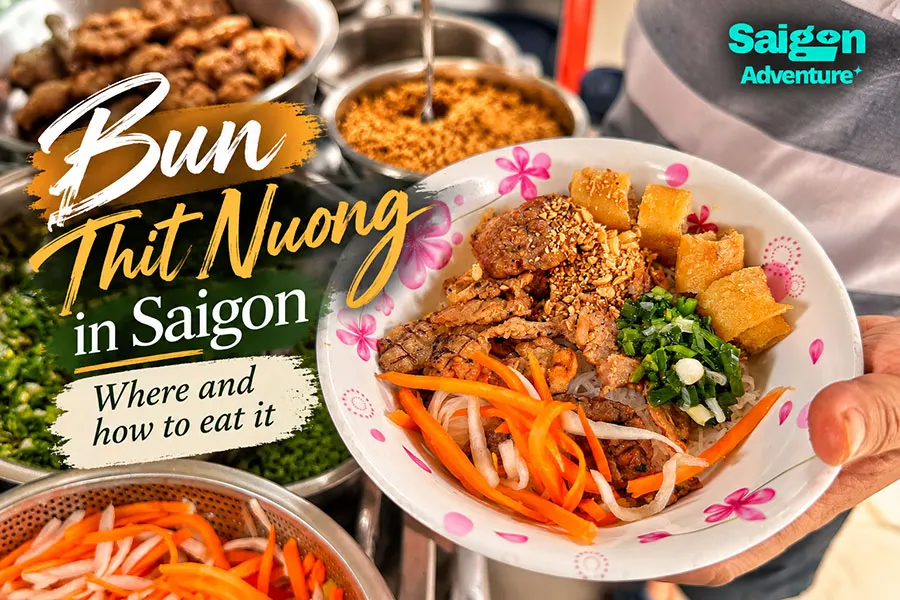
Some of Saigon’s most satisfying meals begin with the irresistible aroma of pork sizzling over a charcoal grill. Follow that smoky scent through a busy neighborhood, and you may discover one of southern Vietnam’s most beloved everyday dishes: bun thit nuong.
This Vietnamese grilled pork noodle bowl combines tender marinated pork, soft rice vermicelli, crisp vegetables, fresh herbs, roasted peanuts, and a sweet-tangy fish sauce dressing. Unlike pho, there is no hot broth. Instead, everything comes together in one refreshing, flavorful bowl.
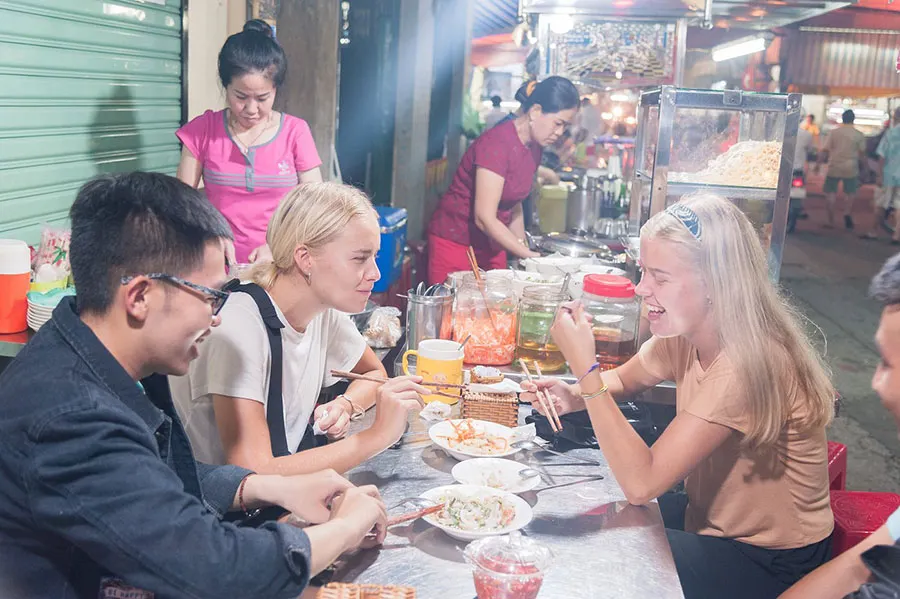
For travelers exploring Ho Chi Minh City’s street food scene, bun thit nuong offers an authentic introduction to the balance of flavors and textures that defines southern Vietnamese cooking.
Whether you’re visiting Saigon for the first time or looking beyond pho and banh mi, this guide covers what to order, how to eat it, where to find it, and what makes a truly memorable bowl.
What is bun thit nuong?
Bun thit nuong (bún thịt nướng) literally translates to rice vermicelli with grilled meat. In Saigon, it typically refers to thin rice noodles topped with marinated grilled pork, fresh vegetables, herbs, roasted peanuts, and a light fish sauce dressing.
The pork is commonly marinated with lemongrass, garlic, fish sauce, and sugar before being grilled until its edges become lightly caramelized.
What makes the dish special is the contrast between warm, smoky meat and cool, refreshing noodles and vegetables.
Unlike Vietnamese noodle soups, bun thit nuong is served without broth. The dressing is added just before eating, allowing you to adjust the flavor to your preference.
It is particularly popular as a casual lunch, although many restaurants also serve it throughout the afternoon or evening.
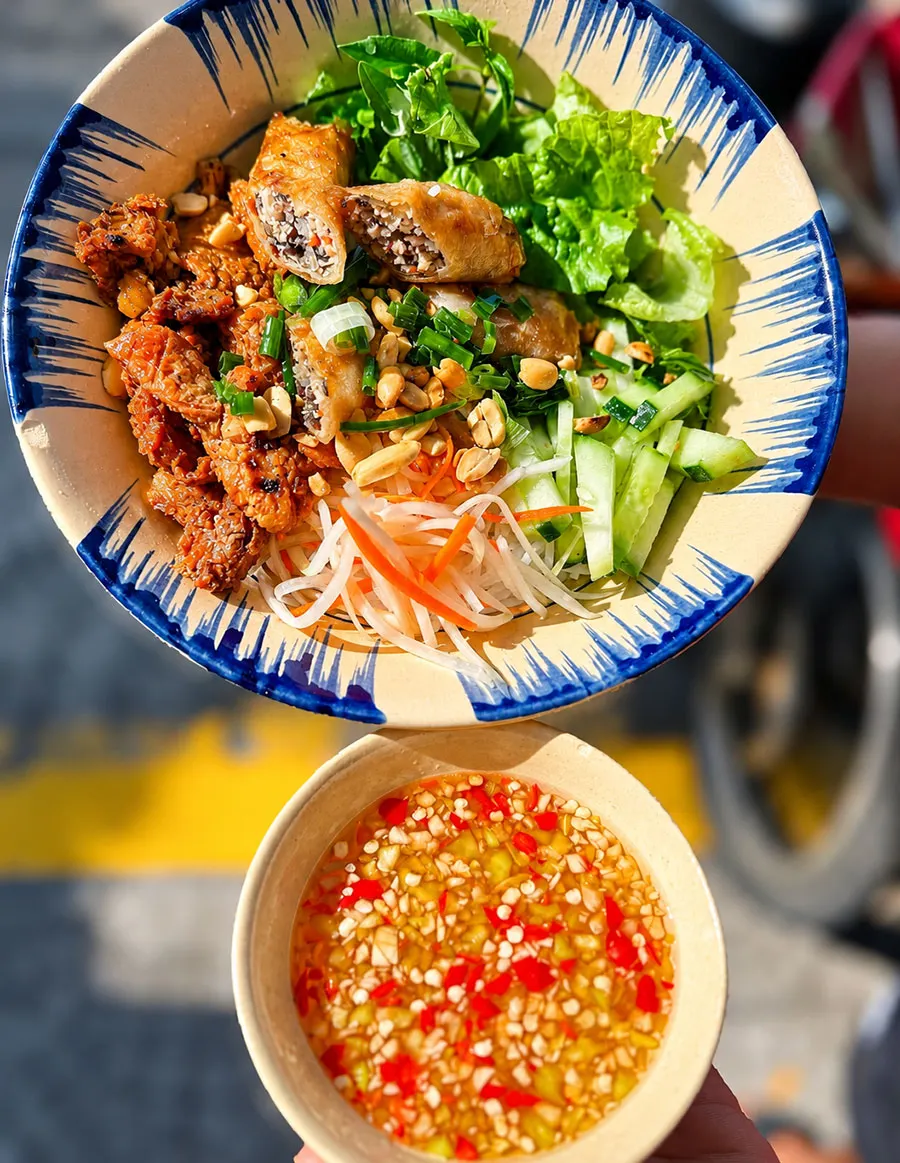
What goes into a traditional Saigon grilled pork noodle bowl?
A good bowl of bun thit nuong is much more than grilled pork and noodles. Each ingredient contributes to its distinctive flavor and texture.
| Ingredient | What it adds |
|---|---|
| Rice vermicelli | Soft, delicate noodles |
| Grilled pork | Smoky, savory, slightly sweet flavor |
| Fresh lettuce and herbs | Freshness and fragrance |
| Cucumber and bean sprouts | Crisp texture |
| Pickled carrots and daikon | Gentle acidity |
| Roasted peanuts | Nutty flavor and crunch |
| Scallion oil | Richness and aroma |
| Fish sauce dressing | Sweet, salty, tangy balance |
| Fried spring roll (optional) | Extra crunch and savory flavor |
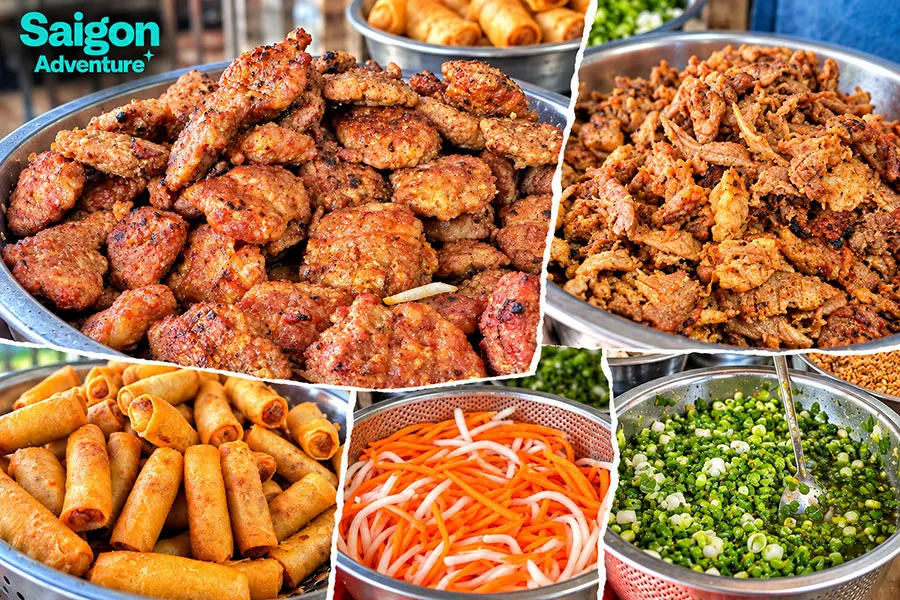
The grilled pork makes the difference
The most memorable part of bun thit nuong is often the pork.
Thin slices of pork shoulder or belly are marinated before grilling. As the meat cooks, its edges develop a lightly caramelized surface while the inside remains tender.
Traditional charcoal grilling adds a particularly appealing smoky aroma, although not every restaurant uses charcoal.
Look for pork with lightly browned edges rather than meat that appears excessively dry or burnt.
Why the fish sauce matters
The dressing, commonly called nuoc cham, ties everything together.
It usually combines diluted fish sauce, sugar, lime juice or vinegar, garlic, and sometimes chili.
A good dressing should not taste overwhelmingly salty or sweet. Instead, it should brighten the noodles, complement the grilled pork, and balance the richness of the toppings.
For many local diners, the sauce is just as important as the meat.
How to eat bun thit nuong like a local
If you’re unfamiliar with Vietnamese dry noodle dishes, your bowl might initially resemble a carefully arranged salad.
However, the best way to enjoy bun thit nuong is to mix everything together.
Step 1: Add the fish sauce
Your bowl may arrive with a small container of nuoc cham on the side.
Start by pouring some dressing over the noodles and vegetables. You can always add more after tasting.
Unlike sauces used only for dipping, this dressing is intended to season the entire bowl.
Step 2: Mix everything together
Use your chopsticks to lift and toss the noodles, grilled pork, herbs, and vegetables.
Try to distribute the dressing evenly so each bite contains a little of everything.
Don’t worry about disturbing the presentation. Mixing is part of the experience.
Step 3: Adjust the flavor
Taste a mouthful before adding anything else.
If you prefer stronger flavors, add more dressing. Fresh chili may be available if you enjoy extra heat.
If your bowl includes lime, squeeze some over the top for additional brightness.
Step 4: Enjoy the different textures
The best bite combines tender noodles, warm grilled pork, fresh herbs, crunchy vegetables, and perhaps a piece of crispy spring roll.
That combination is what makes bun thit nuong such a satisfying meal.
Local tip: Don’t pour all the sauce into the bowl immediately if you’re unsure how strongly seasoned it is. Adding it gradually gives you more control over the flavor.
What to order: Bun thit nuong or bun thit nuong cha gio?
First-time visitors often notice two similar dishes on Vietnamese menus.
The difference is simple, but it can change your meal.
Bun thit nuong – the classic grilled pork bowl
The standard version includes grilled pork, rice noodles, vegetables, herbs, and dressing.
It’s a good choice if you want to focus on the flavor of the marinated meat.
The bowl is usually filling enough for lunch without feeling excessively heavy.
Bun thit nuong cha gio – with crispy spring rolls
This variation adds cha gio, Vietnamese fried spring rolls, usually sliced into bite-sized pieces.
The rolls provide a crunchy contrast to the soft noodles and tender pork.
If you’re trying bun thit nuong for the first time, bun thit nuong cha gio is an especially rewarding choice because it introduces another popular element of southern Vietnamese cooking.
You may also encounter versions with grilled pork sausage, known as nem nuong, or additional grilled meat.
Bun thit nuong is just one of the many dishes that make southern Vietnamese cuisine so appealing. For more local specialties, explore our guide to the best street food in Ho Chi Minh City.
Where to eat bun thit nuong in Ho Chi Minh City
You don’t need an expensive restaurant to enjoy a delicious bowl of bun thit nuong. Some of the most memorable versions come from modest neighborhood eateries where grilled pork is prepared throughout the day.
Here are five places to consider when exploring Saigon’s local food scene.
1. Bun thit nuong Chi Tuyen – A classic District 1 stop
Address: 175C Co Giang Street, District 1.
Bun Thit Nuong Chi Tuyen is a well-known local eatery associated with grilled pork vermicelli and crispy spring rolls.
Its location on Co Giang Street makes it an appealing stop for travelers who want to explore everyday food culture beyond the main tourist streets.
What to order: Bun thit nuong cha gio, combining grilled pork and fried spring rolls.
2. Bun thit nuong Nguyen Trung Truc – Convenient for sightseeing
Address: 1 Nguyen Trung Truc Street, District 1.
This central street-food stop is an option for visitors exploring the Ben Thanh area and nearby attractions.
Expect an informal setting and the familiar combination of grilled pork, rice noodles, fresh vegetables, and traditional dressing.
Best for: A quick, casual Vietnamese lunch between sightseeing stops.
3. Bun thit nuong Hang – A simple neighborhood meal
Address: 27 Yersin Street, District 1.
For travelers who enjoy small local restaurants, Bun Thit Nuong Hang offers another option away from polished tourist dining rooms.
The casual atmosphere is part of the appeal for visitors interested in Saigon’s everyday food culture.
Best for: Travelers looking for an uncomplicated local lunch.
4. Bun thit nuong Ut Thu – Beyond the tourist center
Address: 629/87 Nguyen Dinh Chieu Street, District 3.
Located in a residential lane, this eatery is an option for travelers interested in discovering food spots beyond the city’s main tourist routes.
Best for: Exploring local neighborhoods while enjoying a traditional Vietnamese noodle dish.
5. Bun thit nuong Kieu Bao – A convenient central option
Address: 139 De Tham Street, District 1.
This restaurant is another option for travelers staying near the backpacker district.
Its central location makes it convenient for a casual meal before continuing your exploration of Ho Chi Minh City.
Best for: Visitors seeking a filling Vietnamese lunch near central accommodation.
Local tip: Restaurant addresses, opening hours, and menus can change. Check the latest information before making a special trip.
If you’d rather discover local eateries with someone who knows the neighborhoods, explore Saigon Adventure’s food tours, including motorbike, walking, and private guided experiences.
How much does bun thit nuong cost in Saigon?
Bun thit nuong remains one of Vietnam’s relatively affordable everyday meals.
At a local street stall or small restaurant, a standard bowl may cost approximately 35,000–60,000 VND, while combination bowls with spring rolls or additional meat often cost more.
| Type of bowl | Estimated price |
|---|---|
| Basic grilled pork vermicelli | 35,000–60,000 VND |
| Grilled pork with spring rolls | 45,000–75,000 VND |
| Larger combination bowl | 60,000–90,000+ VND |
These are general planning estimates rather than fixed prices at the restaurants listed above.
Local tip: Before ordering extra spring rolls or meat, check whether the standard bowl already includes them.
When is the best time to eat bun thit nuong?
Bun thit nuong can be enjoyed at different times of the day, although lunch is particularly popular.
The combination of cool noodles, fresh vegetables, and warm grilled pork makes it especially appealing during Saigon’s tropical afternoons.
Many restaurants also serve the dish for dinner, although opening hours vary.
For the best experience, choose a place where the pork is freshly grilled rather than prepared long before serving.
If possible, visit outside the busiest local lunch period for a more relaxed meal.
Bun thit nuong vs bun cha: What’s the difference?
Travelers who have visited Hanoi may notice similarities between bun thit nuong and another famous Vietnamese dish: bun cha.
Both feature grilled pork, rice vermicelli, herbs, and fish sauce, but their serving styles differ.
| Feature | Bun thit nuong | Bun cha |
|---|---|---|
| Region | Southern Vietnam | Northern Vietnam |
| Presentation | Mixed noodle bowl | Separate noodles and pork |
| Sauce | Poured over noodles | Used as a dipping sauce |
| Vegetables | Mixed into the bowl | Usually served alongside |
| Eating style | Toss and eat | Dip and combine |
Bun thit nuong is convenient as a complete one-bowl meal, while bun cha offers a more interactive dipping experience.
Neither is inherently better. They reflect different regional approaches to Vietnamese grilled pork and noodles.
Is bun thit nuong safe for tourists to eat?
Bun thit nuong can be a satisfying choice for international visitors, but food hygiene deserves attention because the dish contains raw vegetables and noodles that may be served at room temperature.
Choose restaurants with clean preparation areas, properly stored ingredients, and thoroughly cooked pork.
Look for a steady flow of customers and avoid food that appears to have been sitting unrefrigerated for extended periods.
What about food allergies?
Traditional bun thit nuong commonly contains fish sauce and roasted peanuts. Depending on the marinade and toppings, other allergens may also be present.
If you have a food allergy, never assume the dish is safe simply because the noodles are made from rice.
Ask about sauces, marinades, garnishes, and cross-contact before ordering.
For more detailed advice, read our guide to eating Saigon street food with food allergies.
Useful Vietnamese phrases for ordering bun thit nuong
A few simple Vietnamese phrases can make ordering easier, especially at small neighborhood restaurants.
| Vietnamese | English meaning |
|---|---|
| Cho tôi một tô bún thịt nướng. | One bowl of grilled pork noodles, please. |
| Cho thêm chả giò. | Please add a fried spring roll. |
| Không cay. | Not spicy. |
| Ít nước mắm thôi. | Just a little fish sauce, please. |
| Không đậu phộng. | No peanuts. |
| Bao nhiêu tiền? | How much is it? |
If pronunciation feels difficult, showing the written phrase on your phone is often enough.
For serious allergies, these phrases alone are not sufficient to confirm that a dish is safe.
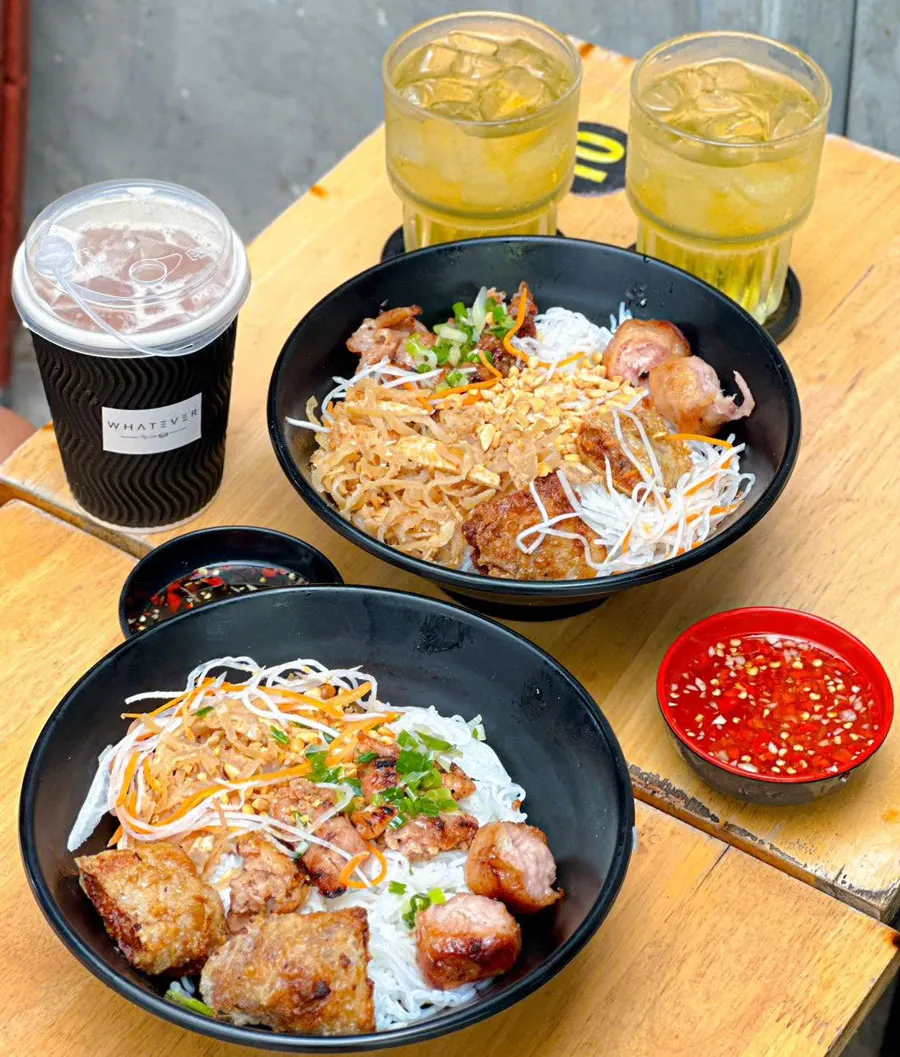
Why bun thit nuong deserves a place on your Saigon food list
Vietnamese cuisine is often introduced through pho, banh mi, and fresh spring rolls. All are worth trying, but bun thit nuong reveals another side of everyday eating in southern Vietnam.
It combines several characteristics that make Saigon’s food culture distinctive: grilled meat, fresh herbs, bright sauces, contrasting textures, and straightforward preparation.
The dish is also approachable for first-time visitors. You can recognize most ingredients, adjust the dressing to your preference, and enjoy a complete meal without ordering several separate dishes.
Perhaps its greatest appeal is how naturally it fits into local life.
A bowl can be a quick lunch between errands, a relaxed afternoon meal, or a simple dinner after a busy day.
Because every kitchen has its own marinade, grilling technique, and sauce balance, trying bun thit nuong at different restaurants can reveal surprisingly different flavors.
Discover authentic Saigon street food with local experts
A bowl of bun thit nuong is a delicious starting point, but Ho Chi Minh City’s food culture extends far beyond a single dish.
From sizzling pancakes and fresh spring rolls to regional noodle specialties and neighborhood desserts, the city rewards travelers willing to explore its smaller streets.
For an introduction to these flavors, browse Saigon Adventure’s street food tours. Our local guides help visitors explore family-run eateries, neighborhood food spots, and the stories behind Vietnamese dishes.
If you’d like to combine food tasting with the excitement of exploring the city by scooter, consider our Saigon motorbike food tour. It’s an opportunity to discover different neighborhoods while enjoying a selection of Vietnamese specialties.
Menus vary by tour, so ask about bun thit nuong before booking if it’s a dish you particularly want to try.
Frequently asked questions about bun thit nuong
Is bun thit nuong served hot or cold?
Bun thit nuong is generally served with warm grilled pork over cool or room-temperature rice vermicelli and fresh vegetables. It is not a hot noodle soup.
Is bun thit nuong spicy?
The standard dish is usually mild. Chili may be included in the dressing or served separately, allowing diners to adjust the heat.
Does bun thit nuong contain peanuts?
Many traditional versions include crushed roasted peanuts. If you have a peanut allergy, ask about toppings and possible cross-contact before ordering.
Can vegetarians eat bun thit nuong?
Traditional bun thit nuong contains pork and usually fish sauce, so it is not vegetarian. Some vegetarian restaurants offer similar noodle bowls with tofu, mushrooms, or plant-based proteins.
What is the difference between bun thit nuong and pho?
Pho is a hot noodle soup served in broth, while bun thit nuong is a mixed rice-vermicelli bowl with grilled pork, vegetables, and dressing.
How much does bun thit nuong cost in Ho Chi Minh City?
A standard bowl at a local eatery may cost approximately 35,000–60,000 VND. Combination bowls with additional toppings generally cost more.
Is bun thit nuong worth trying in Saigon?
Yes. Its combination of smoky grilled pork, fresh herbs, rice noodles, and tangy dressing makes it an approachable introduction to southern Vietnamese cuisine.