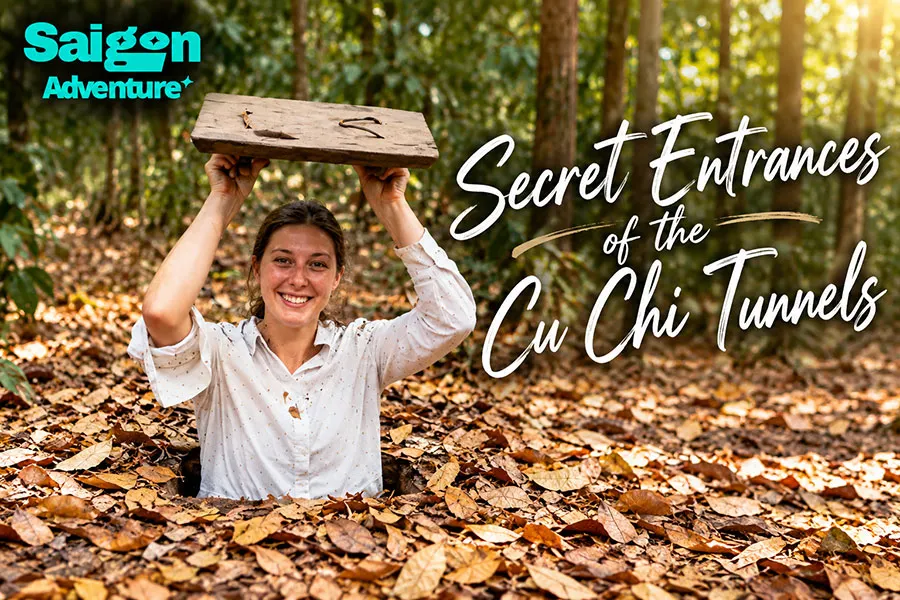
At first glance, the forest floor around the Cu Chi Tunnels may look completely ordinary. Dry leaves cover the ground, trees and shrubs grow nearby, and there may be almost no visible sign that an underground passage lies beneath your feet.
That was exactly the point.
The secret entrances of the Cu Chi Tunnels were designed to blend into the surrounding landscape. Small trapdoors, natural materials and careful camouflage helped conceal access points leading into a much larger underground system.
Today, watching a guide reveal one of these hidden entrances is one of the most memorable experiences during a visit to the Cu Chi Tunnels.
So how were the entrances actually hidden, and why were they so difficult to detect?
Quick Answer: How Were Cu Chi Tunnel Entrances Hidden?
Cu Chi tunnel entrances were concealed using a combination of small trapdoors, compact openings and natural camouflage.
The surface could be covered with materials already found nearby, including:
- Dry leaves
- Loose soil
- Grass
- Small branches
- Natural vegetation
Once the cover was returned to position, the entrance could visually blend into the surrounding forest floor.
The system was effective not because of one single trick, but because of the combination of size, location, camouflage and knowledge of the terrain.

Why Did the Cu Chi Tunnels Need Secret Entrances?
The Cu Chi Tunnels were far more than simple underground hiding places.
The network included passages and areas used for communication, storage, meetings, medical treatment, cooking, sleeping and military activities.
For such a system to function, people needed ways to move between the surface and underground without easily revealing where the tunnels were located.
A large or obvious entrance would have attracted attention immediately.
Concealed access points helped reduce visible signs of underground activity and made the wider tunnel network much harder to identify from the surface.

The Tiny Trapdoors Hidden in the Ground
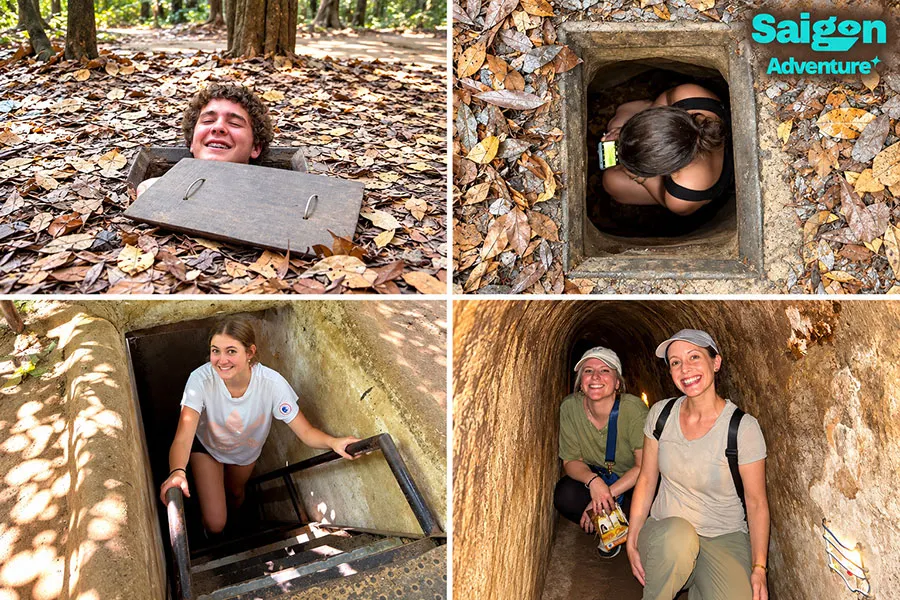
One of the most recognizable features at Cu Chi is the small wooden trapdoor set directly into the ground.
These openings were very different from the large entrances most travelers might imagine.
A person could remove the cover, lower themselves into the narrow opening and then replace the trapdoor above them.
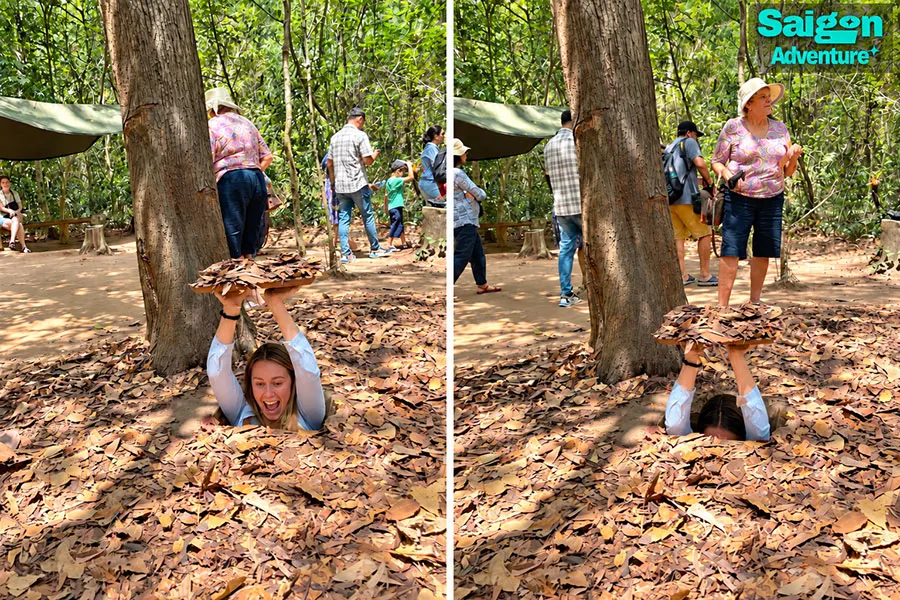
The cover could then be disguised using soil and leaves.
From a short distance away, the entrance might appear to disappear completely into the ground.
Today, guides commonly demonstrate this technique to visitors.
It is one of the simplest but most effective ways to understand how carefully the tunnel system interacted with the landscape above it.

Why Were the Secret Entrances So Small?
Small entrances offered several practical advantages.
First, a compact opening was easier to hide beneath natural ground cover.
Second, it reduced the amount of disturbed soil or vegetation around the entrance.
Third, a smaller opening created fewer obvious visual clues for anyone searching the area.
This is an important detail because camouflage is not only about covering an object.
It is also about reducing everything around that object that might make it noticeable.
A large entrance would require more digging, more displaced soil and a larger surface area to conceal.
A small trapdoor minimized those problems.
How Leaves and Soil Helped Hide the Entrances
The camouflage was effective because it used materials that naturally belonged in the environment.
Instead of covering an entrance with something artificial, leaves and soil could be spread across the trapdoor so that the surface resembled the nearby forest floor.
This created a strong visual advantage.
From several meters away, the concealed entrance might look like nothing more than another patch of earth.
The entrance did not need to become literally invisible.
It only needed to avoid attracting attention.
That difference explains why such a simple-looking camouflage method could be remarkably effective.
The Camouflage Had to Match the Forest Floor
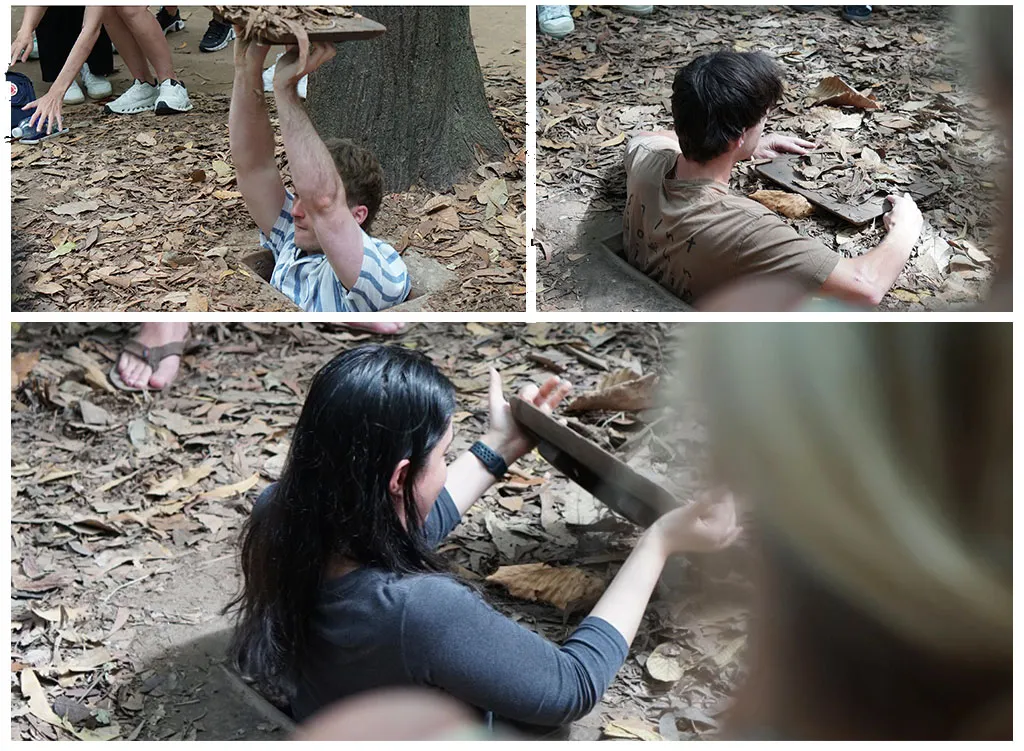
Simply throwing leaves over a trapdoor would not always be enough.
The concealed area had to resemble the surrounding ground.
If the soil looked freshly disturbed or the leaves appeared noticeably different from those nearby, the area could stand out.
Effective concealment therefore depended on visual continuity.
The goal was for someone looking across the ground to see:
leaves, soil and vegetation — not an entrance.
This made local knowledge particularly important.
People familiar with the environment would understand how the ground normally looked and how to avoid creating unnecessary visual clues.
Location Was Just as Important as the Trapdoor
The position of an entrance could make camouflage much more effective.
An opening surrounded by vegetation, trees, roots or uneven ground could be easier to disguise than one placed in a completely open area.
The landscape itself therefore became part of the concealment system.
Natural ground cover helped break up shapes and reduce obvious visual patterns.
This is one reason the Cu Chi Tunnels are easier to understand when you visit the site in person.
Photographs can show a trapdoor, but standing in the surrounding vegetation helps explain why spotting one could have been so difficult.
What Visitors Often Miss About Cu Chi’s Hidden Entrances
Most visitors immediately notice the size of the trapdoor.
But the most interesting part is often everything around it.
When watching a demonstration, look beyond the wooden cover itself.
Notice:
- How similar the soil looks on both sides of the entrance
- How leaves break up the outline of the trapdoor
- How surrounding vegetation reduces visibility
- How little open space the entrance requires
- How difficult it is to identify the exact location once it is covered
This reveals an important aspect of the tunnel system.
The secret was not simply the hidden door.
The secret was how effectively the entrance was integrated into the surrounding environment.
Hidden Entrances Were Only the Beginning
The famous trapdoor was only one component of a much larger underground structure.
Once underground, passages could connect different parts of the tunnel network.
The preserved Cu Chi system includes multiple levels, chambers, communication routes and other underground spaces.
This means the small entrance visible on the surface could lead into something far more complex beneath the ground.
That contrast is one of the most remarkable features of Cu Chi.
What appears to be a tiny opening can represent access to a much larger underground environment.
Ventilation Openings Also Had to Stay Hidden
Entrances were not the only surface features that could reveal the tunnels.
People staying underground still needed fresh air.
That meant ventilation openings had to connect underground spaces with the surface.
These openings also needed to be discreet.
Visitors to Cu Chi can see examples of ventilation systems designed so that surface features blended into the surrounding terrain.
This shows that camouflage was applied to more than just the main entrances.
Any surface feature associated with the underground system could potentially provide clues.
What About Smoke From Underground Kitchens?
Cooking created another challenge.
Even if an entrance remained perfectly hidden, a concentrated plume of smoke could reveal human activity underground.
The tunnel system therefore included methods intended to disperse smoke before it reached the surface.
The famous Hoang Cam kitchen is associated with channels designed to release smoke in a less concentrated and less obvious way.
This is important because it demonstrates how concealment worked as an entire system.
Hiding the entrance alone was not enough.
Signs of underground life also had to be reduced.
Could Someone Walk Over a Hidden Tunnel Entrance Without Seeing It?
Potentially, yes.
That is one of the most surprising aspects of the trapdoor demonstration.
When the entrance is properly covered, someone unfamiliar with its exact position might walk very close to it without immediately recognizing what it is.
Imagine looking across a floor covered with leaves, roots and irregular patches of soil.
Among all of those natural details is one small rectangular opening that has been deliberately made to resemble everything around it.
Unless something attracts your attention, the entrance can be extremely easy to overlook.
How Were Hidden Entrances Discovered?
A concealed entrance was difficult to find, but not impossible.
Any sign of disturbed ground, repeated movement or unusual surface activity could potentially reveal clues.
Searchers might therefore pay attention to changes in soil, vegetation or human activity.
This is why successful camouflage depended on more than simply closing the trapdoor.
The surrounding area also had to remain as natural-looking as possible.
Even a well-hidden entrance became less effective if people repeatedly created obvious tracks or disturbed the vegetation nearby.
Did Every Cu Chi Tunnel Entrance Look the Same?
No.
The tunnel network developed across a large area and over a long period.
Different entrances and tunnel sections were built according to local conditions and their intended functions.
The system should therefore not be imagined as one standardized design repeated everywhere.
Today, Ben Dinh and Ben Duoc are the two best-known Cu Chi visitor areas.
Both help travelers understand how the tunnel network functioned, although the surviving and reconstructed features can vary between different parts of the site.
Ben Dinh or Ben Duoc for Seeing the Tunnel System?
Both areas can provide a valuable introduction to the Cu Chi Tunnels.
Ben Dinh is commonly chosen by travelers who want a convenient visit from Ho Chi Minh City.
Ben Duoc is associated with a larger historic tunnel area and may appeal to visitors interested in spending more time exploring the site.
For first-time visitors, the most important thing is not necessarily choosing one over the other.
It is understanding what you are seeing once you arrive.
Watching a concealed entrance demonstration, examining the tunnel structure and learning how ventilation and underground spaces worked together provide far more context than simply crawling through a short passage.

Can Tourists See Secret Entrances Today?
Yes.
A visit to Cu Chi commonly includes a demonstration of a concealed trapdoor.
Depending on the experience and location, visitors may also see:
- Underground passages
- Ventilation systems
- Kitchen areas
- Shelters
- Defensive positions
- Historical equipment
- Bomb craters
- Tunnel construction features
Some visitor-accessible tunnels have been adapted to make them more practical for modern travelers.
If you prefer a straightforward road journey from Ho Chi Minh City, a Cu Chi Tunnels tour by car is one of the easiest ways to visit.
What Does the Secret Trapdoor Experience Feel Like?
Watching someone enter through the small trapdoor can make the opening look deceptively simple.
Trying it yourself is different.
The entrance is compact, and lowering your body into the opening gives you a much stronger sense of its scale.
For many travelers, this is the moment when the tunnels stop feeling like an abstract historical story.
You suddenly understand how small and discreet some access points could be.
However, entering a tiny opening is not necessary to appreciate the site.
Visitors who dislike confined spaces can stay above ground and still learn a great deal from the demonstrations.

Secret Entrances vs Tourist Tunnel Entrances
Travelers should distinguish between historical-style concealed trapdoors and entrances used for modern tourism.
Visitor-accessible sections may be widened, restored or adapted for safety and convenience.
They should not automatically be treated as exact examples of every original wartime passage or entrance.
The small trapdoor demonstrations are especially useful because they help visitors visualize how discreet a historical access point could be.
The modern Cu Chi site is therefore both a preserved historical location and an educational interpretation of the wider tunnel network.
Why Are the Secret Entrances So Memorable?
The most impressive part is their simplicity.
A wooden cover, a small opening, soil and dry leaves do not sound particularly sophisticated.
But when these elements are carefully combined with the surrounding landscape, they can become remarkably difficult to notice.
That is what makes the secret entrances such a powerful part of the Cu Chi story.
They demonstrate that the effectiveness of the tunnel system depended not only on what was built underground but also on how carefully the surface environment was managed.
Tips for Seeing Hidden Entrances at Cu Chi
When your guide demonstrates a concealed entrance, watch carefully both before and after the cover is replaced.
Look at:
- The outline of the opening
- The size of the trapdoor
- The surrounding leaves and soil
- How level the cover sits with the ground
- How quickly the entrance becomes difficult to recognize
Then look away for a few seconds and try to find the entrance again.
You may be surprised by how quickly an obvious opening disappears into the landscape.
Travelers looking for a different route from Ho Chi Minh City can also consider a Cu Chi Tunnels tour by speedboat.
Are the Secret Entrances the Best Part of Cu Chi?
They are one of the most memorable features, but they are only one part of the experience.
The Cu Chi Tunnels become much more interesting when you understand how different elements worked together.
Hidden entrances, underground passages, ventilation, kitchens, shelters and defensive structures formed an interconnected system.
Instead of viewing the trapdoor only as a photo opportunity, ask what lies beneath it.
Understanding that connection makes the demonstration much more meaningful.
Final Thoughts: How Were the Secret Entrances of the Cu Chi Tunnels Hidden?
The secret entrances of the Cu Chi Tunnels were concealed through a combination of small trapdoors, natural camouflage and careful use of the surrounding landscape.
Leaves, soil and vegetation helped disguise access points so that they blended into the forest floor.
Other surface features, including ventilation openings and signs of cooking activity, also had to be managed carefully to avoid revealing the underground network.
What makes the Cu Chi system so impressive is not only the complexity beneath the ground.
It is how little of that complexity could be seen from above.
For modern visitors, watching a guide reveal a hidden entrance from what appears to be an ordinary patch of earth remains one of the clearest demonstrations of the ingenuity behind the Cu Chi Tunnels.
Travelers who want to experience two major southern Vietnam destinations in one day can also compare a Cu Chi Tunnels and Mekong Delta 1-day tour with visiting Cu Chi separately.
FAQs About Secret Entrances of the Cu Chi Tunnels
How were Cu Chi Tunnel entrances hidden?
The entrances could be concealed with small trapdoors covered by soil, leaves and other natural materials so that they blended into the surrounding ground.
Why were Cu Chi Tunnel entrances so small?
Small openings were easier to conceal and created fewer obvious signs of disturbed soil or vegetation on the surface.
Could soldiers walk past a hidden entrance without seeing it?
Yes. A properly concealed trapdoor could be difficult to recognize among leaves, soil, roots and vegetation, especially for someone who did not know its exact location.
Can tourists enter a secret Cu Chi Tunnel entrance?
Some visitor experiences include demonstrations of small trapdoors. Tourist-accessible tunnel sections are also available, although many have been adapted for modern visitors.
How did people breathe inside the Cu Chi Tunnels?
Ventilation openings connected underground spaces with the surface. These openings also had to be kept discreet so they did not easily reveal the tunnel network.
Are the Cu Chi Tunnels still original?
Parts of the historic network survive around areas such as Ben Dinh and Ben Duoc. Some sections have also been restored or adapted to help visitors explore the site safely.
Is seeing a hidden entrance worth visiting Cu Chi?
Yes. The trapdoor demonstration is one of the clearest ways to understand how carefully the tunnel network was concealed, but the wider tunnel system, kitchens, ventilation and underground spaces make the visit much more complete.